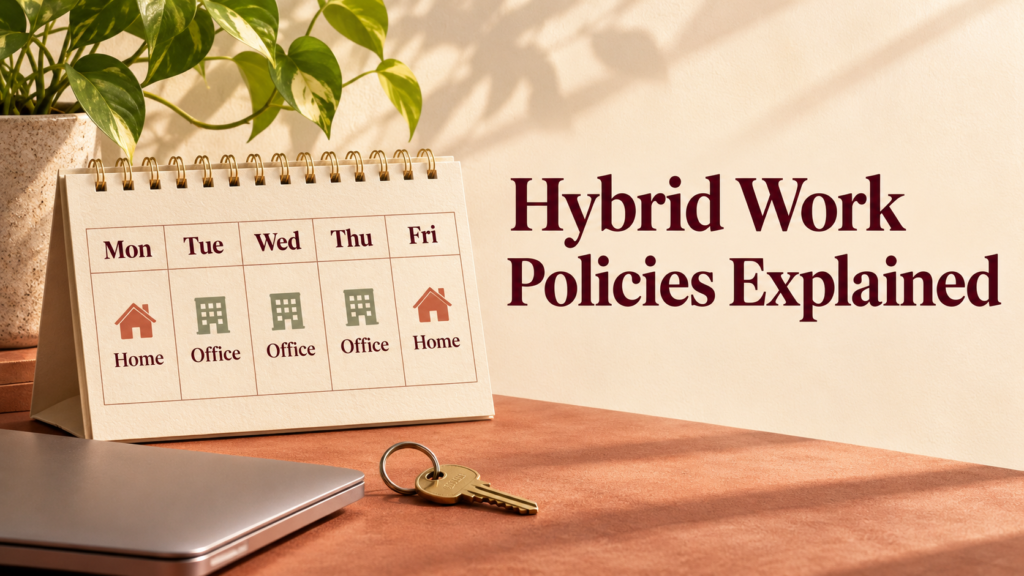
Hybrid work, where employees split their time between a workplace and a remote location, has become a permanent arrangement for many organisations. It promises the best of both worlds: focused work at home and collaboration in person. Yet without a clear policy, hybrid arrangements can quickly become confusing and unfair. Some teams turn up on different days and never overlap. Some employees feel pressure to be in the office more than others. Managers make inconsistent decisions, and questions about expenses, equipment, insurance and tax pile up.
A hybrid work policy sets out the rules and expectations that make the arrangement work. This guide explains what such a policy should cover, the main models organisations use, how to handle eligibility and fairness, the legal and financial issues to consider and how to review the policy over time.
Table of Contents
Why a Written Policy Matters
Informal arrangements may work for a small team with a trusted manager, but they rarely scale. As organisations grow, differences in how managers interpret flexibility create perceptions of favouritism. A written policy creates consistency, gives employees clarity about what they can expect and protects the organisation by showing that decisions are made fairly. It also forms a reference point when disagreements arise and helps new managers apply the rules correctly.
Common Hybrid Models
There is no single hybrid model that suits every organisation. The right choice depends on the nature of the work, client expectations, office space and culture.
| Model | How It Works | Advantages | Challenges |
|---|---|---|---|
| Fixed days | Everyone attends on set days, such as Tuesday to Thursday | Predictable overlap, easier planning | Office crowded on set days, empty otherwise |
| Team-based anchor days | Each team chooses its own in-person days | Fits team needs, encourages collaboration | Cross-team meetings harder to schedule |
| Minimum attendance | Employees attend a set number of days per week or month | Individual flexibility within limits | Teams may rarely overlap |
| Remote-first with gatherings | Mostly remote, with periodic in-person meetups | Wider talent pool, lower office costs | Requires strong digital communication habits |
| Office-first with flexibility | Mostly on site, with occasional remote days | Strong in-person culture | Less appealing to some candidates |
Core Elements of a Hybrid Policy
Purpose and Principles
Open the policy by explaining why the organisation supports hybrid work and the principles guiding decisions. These might include fairness, business needs, collaboration and wellbeing. A short statement of purpose helps people interpret grey areas.
Eligibility
Not every role can be done remotely. Front-line, manufacturing, retail and some customer-facing roles may require full on-site presence. The policy should explain how eligibility is determined, who decides and how employees can request a review. Make the criteria role-based and objective rather than personal, which reduces the risk of discrimination claims.
Attendance Expectations
Spell out how many days or which days employees are expected in the workplace, whether these can be adjusted and how attendance will be tracked, if at all. Clarify what happens during busy periods, client visits or team events.
Working Hours and Availability
Explain core hours, expected response times and how employees should signal availability. If flexible hours are allowed, describe the limits. Remember that rules on working time, rest breaks and overtime still apply regardless of location.
Workspace and Equipment
Set out what equipment the organisation provides, such as laptops, monitors, headsets or chairs, and who is responsible for maintenance and return. Describe any home office allowance and how it is paid. Include guidance on setting up a safe and ergonomic workspace.
Data Security and Confidentiality
Explain rules for handling confidential information outside the office, including use of secure networks, approved devices, password practices and procedures for reporting lost equipment or suspected breaches. Note any restrictions on working in public places or using shared computers.
Expenses
Clarify which costs the organisation will cover, such as internet contributions, travel to the office on anchor days or co-working space fees, and the process for claiming them.
Fairness and Inclusion
Hybrid work can unintentionally create two classes of employees: those who are often in the office and visible to leaders, and those who are mostly remote. To counter proximity bias, ensure that promotions, assignments and recognition are based on clear criteria and outcomes. Run meetings so remote participants have equal voice, for example by having everyone join from their own device when some people are remote.
Flexible arrangements can also be an important form of support for employees with disabilities, caring responsibilities or health conditions. In many jurisdictions, employees have a legal right to request flexible working or reasonable adjustments, and employers must consider such requests properly. The hybrid policy should link to these processes and avoid rigid rules that conflict with them.
Legal, Tax and Insurance Issues
Hybrid policies raise several compliance questions. Employees who work from a different region or country, even temporarily, may create payroll tax, social security or corporate tax obligations for the employer. Many organisations set limits on working from abroad and require approval in advance.
Health and safety duties typically extend to remote workspaces to some degree. Employers may need to provide guidance, carry out or support self-assessments and respond to concerns. Workers’ compensation rules about injuries at home vary, and an injury during work tasks may sometimes be covered. Review whether property insurance covers company equipment at employees’ homes and whether employees’ own home insurance is affected by working from home. Cyber insurance policies may require specific security controls for remote access, and failing to meet them could affect a claim. Tax treatment of home office allowances also varies, so check local rules before setting amounts.
Communicating and Rolling Out the Policy
A policy is only useful if people understand it. Consult employees and managers before finalising it, for example through surveys or focus groups. Where there are employee representatives or unions, consultation may be legally required. Explain the reasoning behind key decisions, provide manager training on applying the policy consistently and publish a short summary alongside the full document.
- Run a pilot period with a few teams before rolling out widely
- Collect feedback on what works and what causes friction
- Provide answers to common questions in a simple guide
- Make sure managers know how to handle requests and exceptions
Making the Office Worth the Trip
If employees commute only to sit on video calls they could have joined from home, they will resent the requirement. Plan in-person days around collaboration: workshops, planning sessions, mentoring, team lunches and creative problem-solving. Coordinate teams so colleagues who need to work together are present on the same days. Invest in meeting rooms with good audio and video so hybrid meetings work for everyone.
A Fictional Example
Ashcombe Insurance Brokers, a fictional firm with 180 employees, started hybrid work with a vague instruction to come in when useful. Within months, some teams never overlapped and new joiners felt lost. The leadership team surveyed staff, then introduced team anchor days, a minimum of two office days per week for eligible roles, a monthly home office allowance and clear rules on working abroad. Managers attended training on inclusive hybrid meetings. Six months later, office usage on anchor days was high, and survey responses showed improved clarity and collaboration.
Reviewing and Updating the Policy
Hybrid work is still evolving. Review the policy at least annually, and sooner if business needs change, office space changes or feedback shows significant problems. Track measures such as employee engagement, retention, productivity indicators, office usage and requests for exceptions. Be honest when something is not working and adjust rather than enforcing rules that no longer fit.
Policy Writing Tips
- Use plain language and avoid legal jargon wherever possible
- Explain the reasons behind each rule, not just the rule itself
- Keep the core policy short and put detailed guidance in appendices
- Build in a fair process for exceptions and appeals
- Coordinate with IT, facilities, finance and legal before publishing
- State clearly that the policy can be reviewed and updated
- Make sure it aligns with employment contracts and other policies
Common Misconceptions About Hybrid Policies
- Thinking hybrid work means employees can work from anywhere in the world
- Assuming a single policy will suit every team without adjustments
- Believing attendance numbers alone measure engagement or productivity
- Ignoring the tax and legal implications of cross-border remote work
- Treating flexibility as a perk that can be withdrawn without consultation
- Assuming remote employees do not need health and safety support
- Forgetting that managers need training to lead hybrid teams fairly
Hybrid Meetings That Work for Everyone
Hybrid meetings, where some people are in the room and others join remotely, are a frequent source of frustration. Remote participants struggle to hear side conversations, miss whiteboard notes and find it hard to interrupt. A few simple rules improve the experience considerably.
- Assign a facilitator who actively invites remote voices into the discussion
- Use a shared digital document or board instead of a physical whiteboard
- Ensure the room has a quality microphone and camera that capture everyone
- Ask in-room attendees to avoid side conversations
- Record decisions and actions in a shared place immediately after the meeting
Some organisations adopt a rule that if one person is remote, everyone joins from their own device. This levels the playing field, especially for brainstorming and decision-making sessions where equal participation matters most.
Final Thoughts
A thoughtful hybrid work policy turns flexibility from a source of confusion into a genuine advantage. It explains who is eligible, when people are expected on site, how work hours and availability are handled, what equipment and expenses are covered and how data stays secure. It also addresses fairness, making sure remote employees are not overlooked, and links clearly to legal rights such as flexible working requests and reasonable adjustments. Behind the scenes, attention to tax, workers’ compensation, insurance and cross-border rules prevents costly surprises. Most importantly, a good policy is not carved in stone. Consult employees, pilot new approaches, measure what matters and update the policy as you learn. Organisations that treat hybrid work as an evolving practice tend to attract and keep strong talent.
Frequently Asked Questions
1. Can an employer change a hybrid arrangement after it has been agreed?
It depends on whether the arrangement forms part of the employment contract and on local law. Where hybrid work is a contractual term, changing it may require consultation or agreement. Where it is a discretionary policy, employers usually have more flexibility but should still give reasonable notice and explain their reasons.
2. Should hybrid policies apply equally to managers and staff?
Generally yes. When leaders follow the same expectations as everyone else, the policy feels fairer and more credible. Leaders who are rarely in the office while requiring others to attend can undermine trust.
3. Is working from another country allowed under a hybrid policy?
Many organisations restrict or require approval for working abroad because of tax, immigration, data protection and employment law issues. Policies often allow short periods with prior permission and prohibit longer stays without a formal review.