Every organisation has a structure, whether it is drawn on a chart or simply understood by the people who work there. Structure decides who reports to whom, where decisions are made, how information flows and how teams coordinate. When the structure fits the strategy, work moves smoothly and people know where they stand. When it does not, the symptoms are familiar: slow approvals, duplicated effort, confused accountability, departments working against each other and talented employees frustrated by bureaucracy.
This guide explains the main types of organisational structure, how each one works, where it tends to succeed and where it struggles. It also covers how to choose or redesign a structure, how structure affects costs, compliance and risk, and how small businesses can think about structure as they grow. By the end, you should be able to look at your own organisation and judge whether its shape is helping or holding it back.
Table of Contents
Why Structure Shapes Performance
Structure is not just an administrative diagram. It influences behaviour every day. If sales and operations report to different leaders with different targets, they may compete rather than cooperate. If every spending decision must go to the chief executive, the business will move only as fast as one person can think. If no one clearly owns customer complaints, they will bounce between departments while customers lose patience.
A good structure aligns authority with responsibility, groups people so that related work happens close together, limits unnecessary layers and makes coordination easier where it matters most. It also needs to suit the organisation’s size, industry, regulatory environment and stage of growth. There is no universally best structure, only structures that fit particular circumstances better than others.
Key Building Blocks of Any Structure
Before comparing types, it helps to understand the dimensions that every structure involves.
- Specialisation, meaning how narrowly jobs are divided into specific tasks
- Departmentalisation, meaning how jobs are grouped, such as by function, product, customer or region
- Chain of command, meaning the line of authority from top to bottom
- Span of control, meaning how many people each manager supervises directly
- Centralisation, meaning whether decisions are made at the top or pushed down to lower levels
- Formalisation, meaning how much behaviour is governed by written rules and procedures
Different combinations of these dimensions produce the structure types described below.
Functional Structure
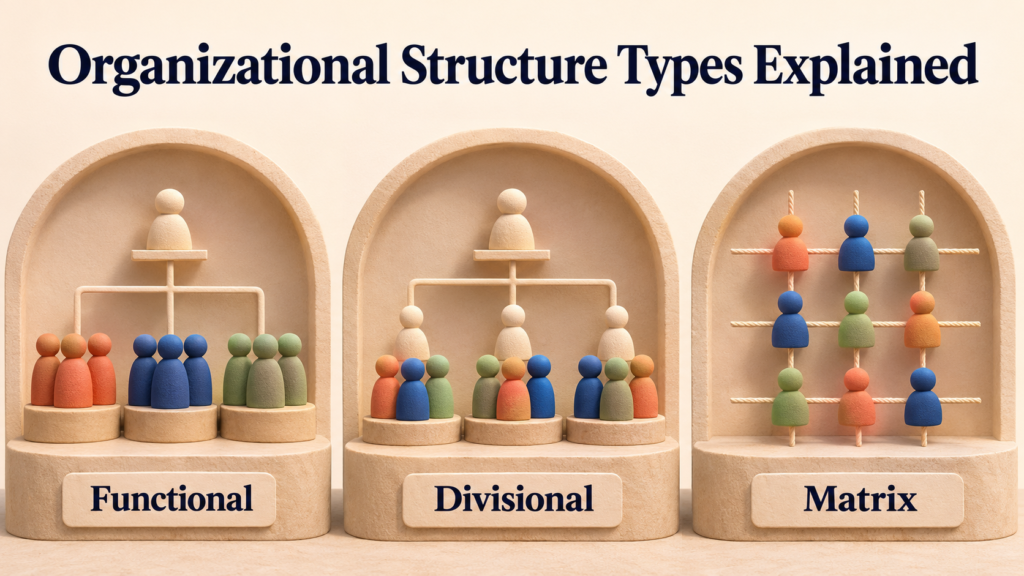
In a functional structure, employees are grouped by specialist area, such as finance, marketing, operations, human resources and IT. Each function has its own leader, who reports to the top executive. This is one of the most common structures, especially in small and mid-sized businesses with a single main product or service.
The strengths are clear. Specialists work together, share knowledge and develop deep expertise. Career paths within each function are easy to understand, and there is little duplication of resources. The weaknesses appear as the organisation grows. Functions can become silos that focus on their own goals rather than the customer. Coordination across functions often has to go up to senior leaders, slowing decisions. Nobody below the top executive owns the end-to-end customer experience.
Divisional Structure
A divisional structure organises the business into semi-independent units, each with its own functions. Divisions can be based on products, customer groups or geographic regions. For example, a manufacturer might have separate divisions for consumer products and industrial products, each with its own sales, marketing and operations teams.
Product-Based Divisions
Product divisions let each unit focus closely on its market and competitors. Leaders have clear accountability for profit and loss, which can encourage entrepreneurial behaviour.
Geographic Divisions
Regional divisions suit organisations operating in markets with different laws, languages, customer preferences or tax rules. A regional leader can respond quickly to local conditions and regulators.
Customer-Based Divisions
Some businesses organise around customer segments, such as small businesses, large enterprises and government clients, because each segment needs different products, pricing and service.
The downside of divisional structures is duplication. Each division may have its own finance, HR and IT teams, increasing costs. Divisions can also compete with each other for resources, and the company may miss opportunities to share expertise across units.
Matrix Structure
A matrix structure combines two dimensions, typically function and project or function and product. Employees report to two managers: a functional manager responsible for their expertise and a project or product manager responsible for the work they deliver. Engineering firms, consulting businesses and large technology companies often use matrix arrangements.
The matrix can make excellent use of specialist talent across many projects and improves coordination on complex work. However, dual reporting creates tension. Employees may receive conflicting instructions, managers may compete for people’s time and decisions can slow while leaders negotiate. Matrix structures need strong communication, clear rules on who decides what and leaders who are comfortable sharing authority.
Flat and Team-Based Structures
Flat structures have few layers of management and wide spans of control. Decisions are pushed down to employees, and communication tends to be faster. Start-ups and small creative businesses often favour this approach. Team-based structures go further, organising work around self-managing teams that take responsibility for outcomes, schedules and sometimes hiring.
These structures can boost speed, engagement and innovation. Yet they have risks. Without clear roles, people may be unsure who decides. Informal power can develop, sometimes less fairly than formal hierarchies. As headcount grows, a flat structure can leave managers with too many direct reports to support properly.
Network and Virtual Structures
In a network structure, a small core organisation coordinates work carried out by external partners, such as contract manufacturers, logistics providers, freelancers and agencies. This allows the business to scale quickly and keep fixed costs low. The core focuses on what it does best, such as design or brand management, while partners handle the rest.
The trade-off is control. Quality, data security and reputation depend on partners. Contracts must be carefully managed, and the business must check that worker classification, insurance and compliance responsibilities are clear. Misclassifying workers as contractors when they function like employees can lead to tax penalties, back-pay claims and liability for benefits in many jurisdictions.
Comparing the Main Structure Types
| Structure | Grouped By | Main Strength | Main Weakness | Often Suits |
|---|---|---|---|---|
| Functional | Specialist area | Deep expertise, efficiency | Silos, slow cross-team decisions | Small to mid-sized single-product firms |
| Divisional | Product, region or customer | Market focus, clear accountability | Duplicated costs, internal rivalry | Larger multi-product or multi-region firms |
| Matrix | Two dimensions at once | Flexible use of specialists | Dual reporting confusion | Project-heavy and complex organisations |
| Flat | Few layers, wide teams | Speed, empowerment | Role ambiguity as size grows | Start-ups and small creative teams |
| Team-based | Self-managing teams | Ownership, engagement | Needs mature team skills | Knowledge work, agile environments |
| Network | Core plus external partners | Low fixed cost, scalability | Less control, partner risk | Asset-light and outsourced models |
| Hierarchical | Clear levels of authority | Clarity, control, compliance | Slow, can discourage initiative | Regulated, safety-critical sectors |
Hierarchical Structures in Regulated Industries
Traditional hierarchies with multiple levels and clear lines of authority are sometimes dismissed as outdated, but they remain valuable in certain settings. Hospitals, airlines, banks, insurers and manufacturers with dangerous processes often need clear accountability, documented approvals and strict adherence to procedures. Regulators may expect named individuals to hold specific responsibilities. In these environments, the clarity and control of a hierarchy can reduce risk, support audits and protect the organisation from penalties.
The challenge is avoiding unnecessary layers and allowing enough flexibility for front-line staff to raise concerns and solve problems quickly. Many regulated organisations combine a formal hierarchy with cross-functional teams for improvement projects.
How Structure Affects Costs and Risk
Every layer of management adds salary, benefits and overhead. Every duplicated function adds cost. At the same time, too few managers can increase risk, because supervisors cannot properly oversee safety, quality and compliance across very large teams. Structure also shapes legal exposure. Unclear responsibility for health and safety, data protection or financial controls can lead to gaps that regulators, auditors or insurers will notice. Insurers assessing business risk may ask how safety oversight is organised, and directors and officers liability considerations often relate to how clearly governance responsibilities are defined.
Choosing or Redesigning a Structure
Start With Strategy
Ask what the organisation is trying to achieve over the next few years. A company focused on cost efficiency may favour functional consolidation. A company focused on rapid innovation in several markets may favour divisions or teams with more autonomy.
Map Current Pain Points
Interview managers and employees about where work gets stuck. Look at decisions that take too long, handoffs that fail and areas where accountability is unclear.
Design Options
Develop two or three alternative structures and test them against criteria such as customer focus, cost, speed, control, talent development and ease of transition.
Plan the Transition
Restructuring affects jobs, reporting lines and sometimes pay. In many jurisdictions, changes that lead to redundancies or significant contract changes require consultation with employees or their representatives, and there may be legal notice periods and severance obligations. Seek HR and legal advice early, communicate clearly and support people through the change.
Structure in Small and Growing Businesses
Most small businesses start with a simple structure in which the owner makes most decisions and everyone reports directly to them. As headcount grows past roughly a dozen people, this becomes hard to sustain. The owner becomes a bottleneck, and employees struggle to get attention. Introducing a first layer of team leaders or functional heads is often the first structural milestone.
Growing businesses should revisit their structure at key moments, such as entering a new market, launching a new product line, merging with another firm or preparing for investment. Investors and lenders often look at whether a business has a management team capable of running operations without depending entirely on the founder.
A Fictional Example
Oakridge Home Services, a fictional company offering plumbing, electrical and heating repairs, grew from 15 to 90 employees in four years. Originally, all technicians reported to the founder, and scheduling, billing and customer service were handled by a small office team. As the business grew, missed appointments and billing errors increased. The founder introduced a divisional structure with three trade-based teams, each led by a senior technician, and a shared services team for scheduling, finance and HR. Clear responsibility for safety and licensing was assigned to each trade lead. Customer complaints fell, and the founder had time to focus on growth and partnerships.
Questions to Diagnose Your Current Structure
- Do employees know who makes which decisions?
- How many approvals does a routine request require?
- Does anyone own the full customer experience from start to finish?
- Are managers supervising too many or too few people?
- Do departments share goals, or do their targets conflict?
- Would a regulator or insurer find clear accountability for safety and compliance?
Tips for Getting Structure Right
- Design the structure around strategy and customers, not individual personalities
- Keep layers to the minimum needed for proper oversight
- Define decision rights clearly, especially in matrix arrangements
- Use cross-functional teams to bridge gaps between departments
- Review spans of control so managers can genuinely support their teams
- Communicate the reasons for any restructuring openly
- Revisit the structure whenever strategy or scale changes significantly
Common Misconceptions About Structure
- Believing a new organisation chart will fix cultural or leadership problems on its own
- Assuming flat structures are always better than hierarchies
- Copying the structure of a large company that operates in a different market
- Restructuring frequently without giving the new design time to work
- Ignoring the informal networks that actually get work done
- Overlooking legal consultation and severance obligations during restructuring
- Thinking structure only matters for large organisations
Final Thoughts
Organisational structure is one of the most powerful and least visible influences on performance. The right shape helps people collaborate, makes accountability clear, speeds up decisions and supports compliance and safety. The wrong shape creates silos, delays and frustration. Functional, divisional, matrix, flat, team-based, network and hierarchical structures each have strengths and weaknesses, and many organisations blend elements of several. The key is to start with strategy, diagnose where work currently gets stuck, test alternative designs and manage any transition carefully, including the legal and human side of change. Revisit the structure as the organisation grows or its strategy shifts. A structure that fits today may not fit in three years, and recognising that early is a sign of healthy leadership.
Frequently Asked Questions
1. What is the most common organisational structure?
The functional structure is among the most common, particularly in small and mid-sized organisations, because it is simple to understand and groups specialists efficiently. Larger organisations often move toward divisional or matrix structures as they diversify.
2. How often should a company review its structure?
Many organisations review structure every few years or whenever there is a major strategic change, such as entering new markets, a merger, rapid growth or a significant shift in technology.
3. Can a company use more than one structure at the same time?
Yes. Hybrid structures are very common. A business might be organised by region at the top level, use functional teams within each region and run cross-functional project teams for major initiatives.