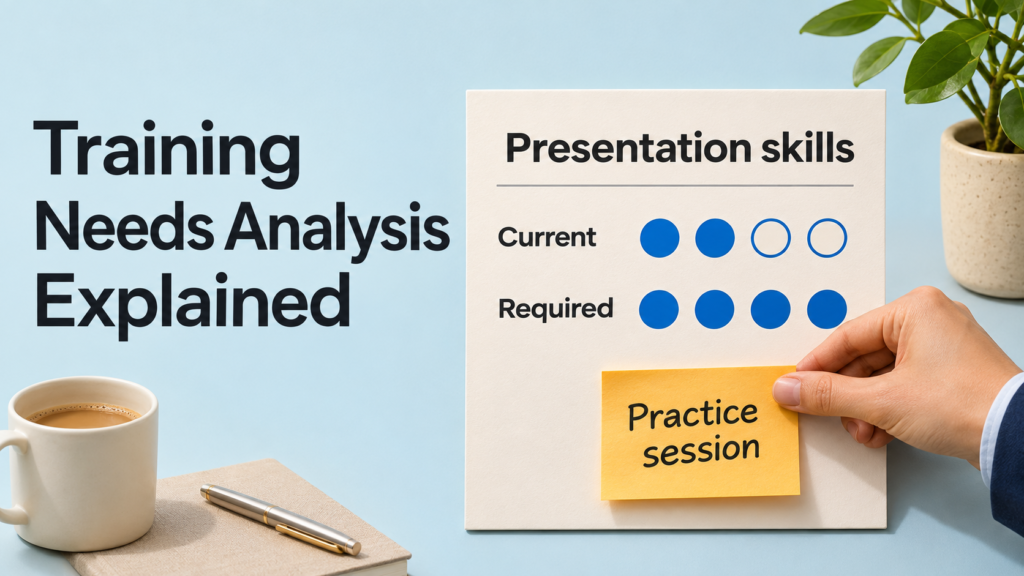
Organisations spend significant sums on training every year, yet much of it misses the mark. Employees sit through courses that do not match their real challenges, managers complain that skills have not improved and budgets get cut when results are hard to see. The root cause is often simple: the training was chosen before anyone properly understood what people actually needed. Training needs analysis is the process that fixes this. It identifies the gap between the skills and knowledge people have today and what they need to perform well, then directs learning investment to where it will make the biggest difference.
This guide explains what training needs analysis is, the levels at which it can be carried out, practical methods for gathering information, how to prioritise needs, how to turn findings into a training plan and how to measure results. It also touches on compliance training, safety obligations and the financial side of learning investment, including budgeting and potential tax considerations.
Table of Contents
What Training Needs Analysis Means
Training needs analysis, sometimes called a learning needs assessment, is a structured investigation into performance gaps and their causes. It asks what people need to be able to do, what they can do now, why any gap exists and whether training is the right solution. That last question matters. Not every performance problem is caused by a lack of skill. Poor tools, unclear processes, unrealistic targets or low motivation can all look like skills gaps but will not be fixed by a course.
Three Levels of Analysis
A common approach looks at needs at three levels. Each provides a different perspective, and combining them gives the clearest picture.
Organisational Level
This looks at the business strategy and asks what capabilities the organisation will need. If the company plans to expand into new markets, adopt new technology or meet new regulations, it will need new skills. Organisational analysis also considers culture, budget and leadership support for learning.
Task or Role Level
This examines specific jobs and the knowledge, skills and behaviours required to perform them well. Job descriptions, competency frameworks, process documents and observation of top performers all help define the standard.
Individual Level
This compares each person’s current capability with the requirements of their role and their career goals. Performance reviews, self-assessments, skills tests and manager input are common sources.
Methods for Gathering Information
No single method gives the full picture. Most analyses combine several sources to cross-check findings.
| Method | What It Reveals | Effort Required | Main Limitation |
|---|---|---|---|
| Surveys and questionnaires | Broad view of perceived needs across many people | Low to medium | People may not know what they do not know |
| Interviews | Detailed insight into challenges and causes | Medium to high | Time-consuming, small sample |
| Focus groups | Shared issues and team-level perspectives | Medium | Dominant voices can skew results |
| Observation | How work is really done | Medium to high | People may behave differently when watched |
| Performance data | Objective evidence of gaps such as errors or delays | Low if data exists | Does not explain causes |
| Skills assessments | Measured capability against a standard | Medium | Must be well designed to be valid |
| Customer feedback | Impact of skills gaps on service | Low to medium | Indirect and sometimes anecdotal |
Running a Training Needs Analysis Step by Step
Define the Scope and Goals
Decide whether the analysis covers the whole organisation, a department, a role or a specific problem. Clarify what business outcomes the analysis supports, such as reducing errors, improving customer satisfaction or preparing for a new system.
Identify Required Capabilities
List the knowledge, skills and behaviours needed for success. Involve managers and high performers, review job descriptions and consider future requirements rather than only today’s tasks.
Assess Current Capability
Gather evidence using the methods above. Look for patterns across groups as well as individual gaps.
Analyse Gaps and Root Causes
Compare required and current capability. For each gap, ask why it exists. If the cause is a lack of knowledge or skill, training may help. If the cause is poor tools, unclear expectations or conflicting incentives, other solutions are needed.
Prioritise
Not every gap can be addressed at once. Prioritise based on business impact, risk, number of people affected, urgency and cost of addressing the gap.
Recommend Solutions
Choose the right mix of learning approaches, such as workshops, online modules, coaching, on-the-job training, job aids or mentoring. Estimate costs and timelines.
Report and Agree
Share findings with decision-makers in a concise report that links each recommendation to business outcomes. Agree on the plan, budget and responsibilities.
Compliance and Safety Training Needs
Some training is not optional. Depending on the industry and location, employers may be legally required to provide health and safety training, anti-harassment training, data protection training, food hygiene certification, equipment operation licences or industry-specific qualifications. A training needs analysis should map these mandatory requirements and track who needs refresher training and when.
Gaps in required training can have serious consequences. An employee injured while operating equipment without proper training may lead to regulatory investigations, fines and higher workers’ compensation costs. Insurers may also ask about training records when assessing risk or handling claims. Keeping accurate records of who has completed which training, and when it expires, is a practical way to reduce both legal and financial exposure.
Budgeting and Return on Learning
A needs analysis helps justify the training budget by linking spending to clear business outcomes. Estimate the cost of each proposed solution, including course fees, materials, trainer time and the hidden cost of employee time away from work. Compare these with the expected benefits, such as fewer errors, faster onboarding, lower turnover or higher sales.
In many jurisdictions, training that maintains or improves skills needed for the employee’s current role may be treated as a deductible business expense, and some governments offer grants, levies or tax incentives for workforce training or apprenticeships. Rules vary considerably, so a conversation with an accountant before planning a major programme can uncover funding that reduces the net cost.
Training Needs Analysis in Small Businesses
Small businesses rarely have dedicated learning teams, but they can still carry out effective needs analysis. A simple approach is to list each role, note the three to five skills that matter most and ask each employee and their manager to rate current capability. Combine this with customer feedback and any recurring problems, such as complaints or rework. Even a short exercise like this helps owners spend limited training budgets wisely.
A Fictional Example
Granite Peak Hotels, a fictional group of three hotels, noticed rising guest complaints about check-in delays. Management initially planned customer service training for all front desk staff. A needs analysis revealed a different picture. Interviews and observation showed that most staff were friendly and capable, but the property management system was confusing and new staff received little training on it. The group invested in short system training, created quick reference guides at each desk and fixed several settings in the software. Complaints dropped significantly, and the cost was far lower than the original plan.
Questions to Guide Your Analysis
- What business problem or goal is this analysis meant to support?
- What does excellent performance look like in this role?
- Where are the biggest gaps between current and required performance?
- Is lack of skill the true cause, or are other factors involved?
- Which gaps carry legal, safety or financial risk?
- How will we know if the training worked?
Tips for an Effective Analysis
- Start with business goals rather than a list of available courses
- Use more than one data source to confirm findings
- Involve managers early so they support the resulting plan
- Ask employees about their own needs and career goals
- Separate skill gaps from process, tool or motivation problems
- Keep the final report short and focused on decisions
- Repeat the analysis regularly, especially after major changes
Common Mistakes and Misconceptions
- Assuming every performance problem needs a training solution
- Relying only on employee wish lists for course topics
- Skipping the analysis and buying popular programmes instead
- Ignoring mandatory compliance and safety training requirements
- Failing to measure whether training changed performance
- Treating the analysis as a one-time exercise
- Overlooking informal learning such as coaching and job aids
Turning Findings Into a Learning Plan
A training needs analysis is only valuable if it leads to action. Translate the prioritised needs into a learning plan that shows what will be delivered, to whom, by when, at what cost and who is responsible. Group related needs so that one solution addresses several gaps at once. For example, a single workshop on customer escalation might cover communication skills, system knowledge and complaint procedures together.
Choose formats that suit both the learning goal and the workforce. Hands-on skills are best developed through practice and coaching, while knowledge updates can often be handled through short online modules. Shift workers and field staff may need learning delivered in short bursts on mobile devices rather than long classroom sessions. Build in reinforcement, such as follow-up quizzes, manager check-ins and job aids, so that new skills stick after the initial session.
Evaluating Training Outcomes
Close the loop by checking whether training actually closed the gaps identified. A widely used approach looks at four levels: how participants reacted to the training, what they learned, whether their behaviour changed on the job and whether business results improved. Reaction and learning are easiest to measure but least meaningful on their own. Behaviour change and results take longer to observe but show the real value of the investment. Compare performance indicators before and after training, gather manager observations and repeat skills assessments where practical. Feed these findings into the next needs analysis cycle.
Final Thoughts
Training needs analysis is the difference between training that changes performance and training that simply fills calendars. By starting with business goals, defining what good performance looks like, gathering evidence from several sources and asking honestly whether training is the right fix, organisations can direct their learning budgets where they will have real impact. The process also protects the business by highlighting mandatory safety and compliance requirements, reducing the legal, regulatory and insurance risks that come with untrained staff. It does not need to be complicated or expensive. A focused analysis for one team or one problem can deliver valuable insights within weeks. Repeat it regularly, measure results and refine your approach, and your training investment will steadily become more effective.
Frequently Asked Questions
1. How often should a training needs analysis be done?
Many organisations carry out a broad analysis annually, linked to business planning, with smaller targeted analyses whenever there are major changes such as new technology, regulations or restructuring.
2. Who should carry out a training needs analysis?
It is often led by HR or learning specialists, but managers, employees and subject matter experts should all contribute. In small businesses, the owner or a senior manager can lead a simple version.
3. What is the output of a training needs analysis?
The output is usually a short report or plan that lists prioritised needs, recommended learning solutions, costs, timelines, responsibilities and measures of success.