Every team goes through a journey. When people first come together, they are often polite and uncertain. Soon, disagreements surface as personalities and ideas collide. With effort, the team develops shared norms, and eventually it may reach a stage where members work together smoothly and achieve strong results. Understanding these stages helps leaders and team members recognize what is happening, respond appropriately and move faster toward high performance.
This guide explains the stages of team development. It covers Bruce Tuckman’s model, each stage in detail, signs of each stage, the leader’s role, what team members can do, tools and activities for each stage, how teams move backward, applying the model to remote teams and projects, other team development models, limitations, practical tips and common mistakes.
Table of Contents
Tuckman’s Model of Team Development
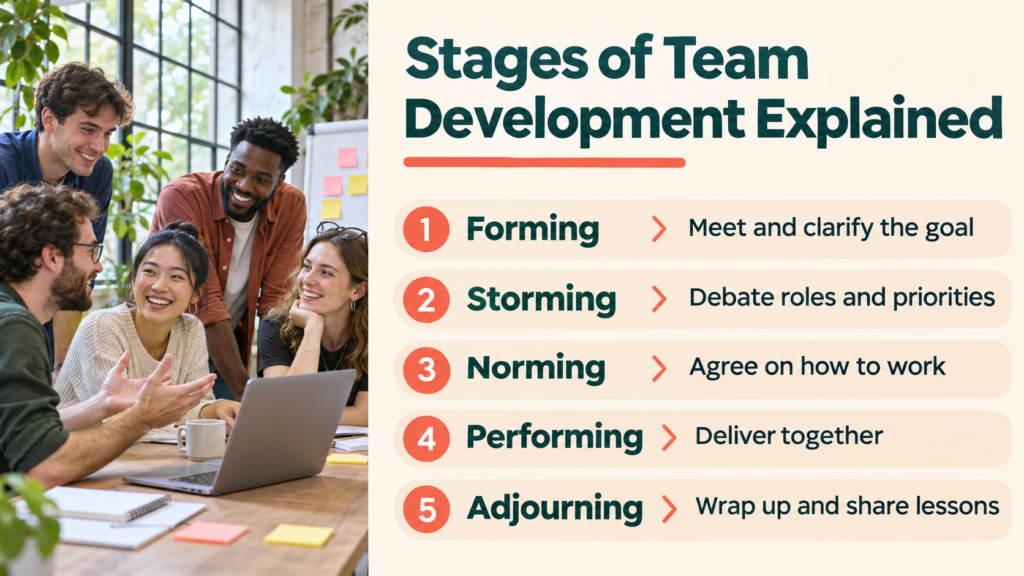
In 1965, psychologist Bruce Tuckman published a model describing four stages of group development: forming, storming, norming and performing. In 1977, Tuckman and Mary Ann Jensen added a fifth stage, adjourning, describing what happens when a team completes its work and disbands. The model remains one of the most widely used frameworks for understanding team dynamics.
The Five Stages at a Glance
| Stage | Team Mood | Typical Behaviors | Leader Focus |
|---|---|---|---|
| Forming | Polite, uncertain, excited | Getting to know each other, seeking direction | Provide clarity, structure and purpose |
| Storming | Tense, frustrated, competitive | Disagreements, power struggles, questioning goals | Manage conflict, coach, reinforce purpose |
| Norming | Cooperative, growing trust | Agreeing on roles, processes and norms | Facilitate, encourage ownership |
| Performing | Confident, motivated | High productivity, independent problem-solving | Delegate, support development, remove obstacles |
| Adjourning | Satisfaction mixed with sadness | Wrapping up, celebrating, reflecting | Recognize contributions, capture lessons |
Stage 1: Forming
In the forming stage, team members are new to each other or to the team’s task. They are often polite, cautious and eager to make a good impression. People rely on the leader for direction.
Signs of Forming
- Uncertainty about goals and roles.
- Limited open disagreement.
- Questions about how the team will work.
- Excitement mixed with anxiety.
What Helps
- Clear purpose, goals and expectations.
- Defined roles and responsibilities.
- Introductions and icebreakers.
- Basic ground rules for communication and meetings.
Stage 2: Storming
As people begin working together, differences in opinions, working styles and priorities emerge. Conflict may arise over goals, roles, leadership and processes. Storming can feel uncomfortable, but it is a natural and often necessary part of development.
Signs of Storming
- Disagreements and debates.
- Resistance to tasks or leadership.
- Frustration over progress.
- Formation of subgroups or alliances.
What Helps
- Acknowledging that conflict is normal.
- Encouraging respectful debate focused on ideas, not people.
- Clarifying goals and decision-making processes.
- Coaching individuals and mediating conflicts.
- Revisiting roles if confusion persists.
Teams that avoid storming entirely may never build real trust or surface important ideas.
Stage 3: Norming
In the norming stage, the team resolves major conflicts and develops shared norms. Members agree on how to work together, respect each other’s strengths and feel growing commitment to goals.
Signs of Norming
- Clear roles and processes.
- Increased trust and cooperation.
- Constructive feedback.
- Shared responsibility for results.
What Helps
- Documenting team norms and agreements.
- Encouraging team members to take ownership.
- Recognizing progress and collaboration.
- Gradually sharing leadership responsibilities.
Stage 4: Performing
At the performing stage, the team works effectively and independently toward goals. Members understand each other, communicate openly and handle disagreements constructively. The team can adapt to challenges without constant direction.
Signs of Performing
- High productivity and quality.
- Independent decision-making.
- Strong trust and mutual support.
- Focus on continuous improvement.
What Helps
- Delegating authority.
- Providing development opportunities.
- Removing obstacles and securing resources.
- Celebrating achievements.
- Keeping the team challenged with meaningful goals.
Stage 5: Adjourning
When a project ends or a team disbands, members experience adjourning. Feelings may include pride, satisfaction and sadness about the team ending. Some describe this stage as “mourning.”
What Helps
- Celebrating accomplishments.
- Recognizing individual contributions.
- Holding a lessons-learned review.
- Supporting members as they move to new roles.
The Leader’s Role Through the Stages
Leadership style often shifts as teams develop. Early on, leaders provide more direction. During storming, they coach and mediate. In norming, they facilitate and support. In performing, they delegate and empower. This approach aligns with situational leadership ideas, where leaders adapt their style to the team’s readiness.
What Team Members Can Do
- Be open about expectations and working preferences.
- Listen actively and respect different views.
- Address conflicts directly and respectfully.
- Contribute to setting team norms.
- Support colleagues and share knowledge.
- Give and receive feedback constructively.
Tools and Activities for Each Stage
- Forming: team charters, icebreakers, role clarification exercises.
- Storming: conflict resolution workshops, communication style assessments, facilitated discussions.
- Norming: team agreements, feedback sessions, process mapping.
- Performing: goal-setting with OKRs, innovation sessions, stretch projects.
- Adjourning: retrospectives, celebrations, recognition events.
Teams Can Move Backward
Team development is not always linear. Teams can return to earlier stages when:
- New members join or key members leave.
- Leadership changes.
- Goals or priorities shift.
- Major stress or crisis occurs.
- Organizational restructuring happens.
Recognizing a return to storming, for example, helps leaders respond rather than assuming the team is failing.
Applying the Model to Remote Teams
Remote teams go through the same stages but may experience them differently. Forming can take longer without in-person interaction, and storming may be hidden because conflicts surface less openly online. Helpful practices include regular video meetings, clear communication norms, virtual team building, explicit check-ins about how the team is working and occasional in-person gatherings.
Applying the Model to Projects
Project teams often move through all five stages within the project lifecycle. Project managers can plan for each stage, such as kickoff workshops for forming, conflict resolution processes for storming, clear workflows for norming, empowerment during performing and a structured close-out for adjourning.
Other Team Development Models
- Lencioni’s Five Dysfunctions of a Team: focuses on trust, conflict, commitment, accountability and results.
- Katzenbach and Smith’s team performance curve: describes progress from working groups to high-performing teams.
- Hackman’s team effectiveness conditions: emphasizes a real team, compelling direction, enabling structure, supportive context and expert coaching.
These models complement Tuckman’s by focusing on specific conditions and behaviors for team success.
Limitations of the Model
- Stages may overlap or occur in different orders.
- Some teams skip stages or remain stuck.
- The model was based on research with small groups and may not capture all modern team contexts.
- It describes stages but offers limited detail on how long each lasts.
Practical Tips
- Share the model with your team so everyone understands the journey.
- Discuss openly which stage the team is in.
- Adapt leadership style to the stage.
- Treat conflict as a sign of growth when handled well.
- Revisit norms when team membership changes.
- Celebrate progress at each stage.
Common Mistakes
- Avoiding conflict instead of managing it.
- Expecting high performance immediately.
- Using the same leadership approach throughout.
- Ignoring the impact of new members.
- Skipping celebration and reflection at the end of projects.
Questions to Diagnose Your Team’s Stage
- Do team members clearly understand the team’s purpose and their roles?
- Are disagreements discussed openly, or avoided?
- Has the team agreed on how it makes decisions and communicates?
- Can the team solve problems without the leader stepping in?
- Do members trust each other enough to give honest feedback?
- How did the team react to the last major change or new member?
Discussing these questions openly with the team can help members recognize where they are and what they need to move forward.
Creating a Team Charter
A team charter is a short document created by the team that helps it move through forming and storming more quickly. A typical charter includes the team’s purpose, goals, roles and responsibilities, decision-making process, communication norms, meeting rhythms, how conflicts will be handled and how success will be measured. Revisiting the charter when the team changes or struggles helps restore clarity.
Leading Through Storming
Storming is where many teams stall. Leaders can help by setting clear expectations for respectful disagreement, separating people from problems, using structured discussion methods, addressing persistent conflicts privately and reminding the team of its shared purpose. Training in conflict resolution and feedback skills can also help team members handle disagreements constructively. In some cases, an external facilitator can help a team work through deeper tensions.
Sustaining High Performance
Reaching the performing stage is an achievement, but staying there requires ongoing attention. High-performing teams benefit from fresh challenges, opportunities for growth, regular reflection on what is working and recognition of their success. Leaders should watch for complacency, burnout and changes in membership that may push the team back to earlier stages.
A Fictional Team Journey
A fictional product team forms to launch a new mobile app. In forming, members are polite and look to the project lead for direction, so she sets clear goals and roles. Within weeks, designers and engineers clash over priorities, and the team enters storming. The lead facilitates a session to agree on decision rules and a shared roadmap. In norming, the team adopts weekly demos and honest feedback. By launch, the team is performing, solving problems quickly with little oversight. After launch, a celebration and retrospective mark adjourning before members move to new projects.
Using the Model in Team Conversations
Many teams find it useful to discuss the model openly at kickoffs and retrospectives. Asking “Which stage are we in, and what would help us move forward?” normalizes conflict, encourages honest reflection and gives members a shared language for talking about how the team is working, not just what it is producing.
How Long Each Stage Lasts
There is no fixed timeline. A short project team may move through all stages in weeks, while a permanent department may take many months to reach performing. Team size, task complexity, leadership quality and how often membership changes all influence the pace. Focus on signs of progress rather than the calendar.
Final Thoughts
Bruce Tuckman’s model, introduced in 1965 and expanded with Mary Ann Jensen in 1977, describes how teams typically move through forming, storming, norming, performing and adjourning. Each stage has its own challenges and needs, from clarity and structure early on, to conflict management, to shared norms, empowerment and finally reflection and recognition. Teams can move backward when membership or circumstances change, and remote or project teams experience the stages in their own ways. By recognizing where a team stands and adapting leadership accordingly, leaders and members can help teams reach high performance more quickly and sustain it longer. Use it to guide, not label.
Frequently Asked Questions
1. What are the five stages of team development?
The five stages are forming, storming, norming, performing and adjourning, based on Bruce Tuckman’s model.
2. Who created the stages of team development?
Bruce Tuckman described the first four stages in 1965, and he added the adjourning stage with Mary Ann Jensen in 1977.
3. Is conflict during the storming stage bad?
Not necessarily. Storming is a normal stage, and conflict handled respectfully can lead to stronger trust, better ideas and clearer norms.