One of the most important strategic choices a business makes is how it will compete. Will it win by offering the lowest prices, made possible by having the lowest costs? Or will it win by offering something unique that customers are willing to pay more for? These two approaches, cost leadership and differentiation, are among the most influential ideas in strategy. Understanding them helps businesses avoid being stuck in the middle with no clear advantage.
This guide compares cost leadership and differentiation. It covers their origins in Porter’s generic strategies, how each works, sources of advantage, requirements, risks, examples, the focus strategy, the debate over combining strategies, how to choose, measuring success, implementation tips and common mistakes.
Table of Contents
Porter’s Generic Strategies
Michael Porter of Harvard Business School described three generic strategies for achieving competitive advantage: cost leadership, differentiation and focus. Focus can be pursued through cost or differentiation within a narrow segment. Porter argued that firms trying to do everything at once risk being “stuck in the middle,” with neither the lowest costs nor a strong point of difference.
What Cost Leadership Means
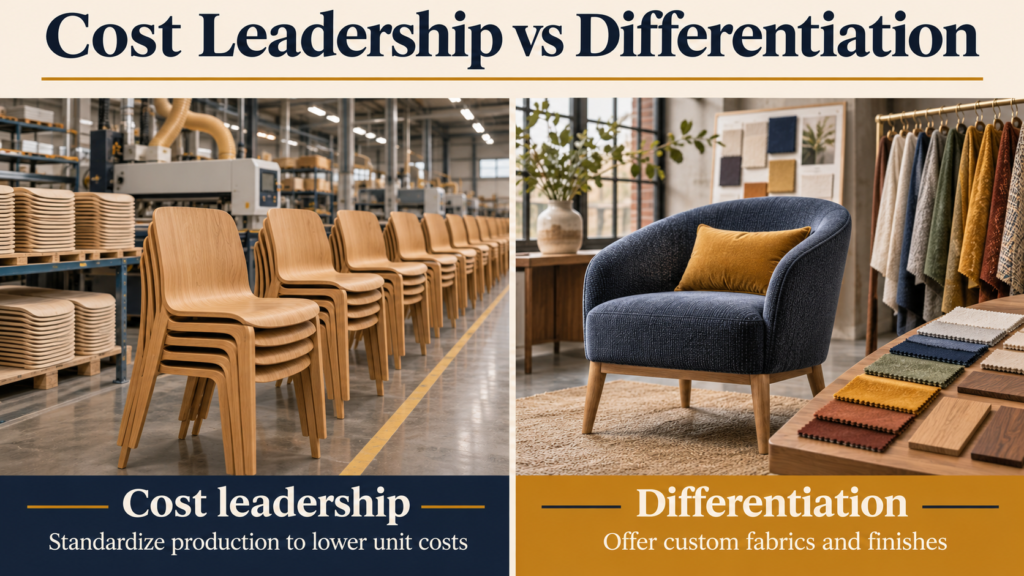
Cost leadership means becoming the lowest-cost producer in an industry while offering acceptable quality. A cost leader can either charge lower prices than competitors and win volume, or charge similar prices and earn higher margins. Cost leadership is not simply about low prices; it is about structurally lower costs that rivals cannot easily match.
Sources of Cost Advantage
- Economies of scale: spreading fixed costs over large volumes.
- Efficient processes and automation.
- Strong supplier bargaining power and purchasing efficiency.
- Simplified product ranges and standardization.
- Low overheads and lean organization.
- Advantageous locations near materials or customers.
- Learning curve effects from experience.
- Technology that reduces labor or material costs.
What Differentiation Means
Differentiation means offering products or services that customers perceive as unique and valuable, allowing the company to charge premium prices or build strong loyalty. Differentiation can come from many sources, and it must be something customers actually care about.
Sources of Differentiation
- Product quality, performance and durability.
- Design and aesthetics.
- Brand reputation and image.
- Innovation and unique features.
- Customer service and support.
- Customization and personalization.
- Convenience, speed and availability.
- Sustainability and ethical practices.
Comparing the Two Strategies
| Aspect | Cost Leadership | Differentiation |
|---|---|---|
| Core aim | Lowest costs in the industry | Unique value customers will pay for |
| Pricing | Low or average prices | Premium prices |
| Customer target | Price-sensitive mass market | Customers who value specific benefits |
| Key capabilities | Efficiency, scale, cost control | Innovation, marketing, quality, service |
| Typical investment | Process improvement, automation, scale | Research, design, branding, talent |
| Main risks | Price wars, imitation, quality perceptions | Imitation, costs rising too high, changing tastes |
| Culture | Discipline and frugality | Creativity and customer focus |
Requirements for Cost Leadership
- Large market share or access to high volumes.
- Capital for efficient equipment and technology.
- Tight cost controls and frequent reporting.
- Simple, standardized products.
- Strong supply chain management.
- Incentives based on efficiency targets.
Requirements for Differentiation
- Deep understanding of customer needs.
- Strong marketing and brand-building skills.
- Investment in research, design and innovation.
- High-quality materials and processes.
- Skilled, motivated employees, especially in service roles.
- Coordination between marketing, product and operations.
Risks of Cost Leadership
- Competitors may find even cheaper ways to produce.
- Technological change can wipe out cost advantages.
- Focusing on cost can lead to quality problems that damage reputation.
- Price wars reduce profits for everyone.
- Customer preferences may shift toward features or experiences.
- Cost-cutting can affect safety, compliance or employee morale if taken too far.
Risks of Differentiation
- Competitors may copy distinctive features.
- The price premium may become too large for customers to accept.
- Customers may stop valuing the differentiating factor.
- High costs can erode margins if premiums fall.
- Differentiation that customers do not notice wastes money.
The Focus Strategy
The focus strategy targets a narrow market segment, such as a specific region, customer group or niche product. It comes in two forms:
- Cost focus: being the low-cost provider within a niche.
- Differentiation focus: offering specialized value to a niche.
Focus strategies are common among small businesses that cannot compete with large firms across the whole market but can serve a specific segment exceptionally well.
Can You Combine Cost Leadership and Differentiation?
Porter warned against being stuck in the middle, but later thinkers pointed out that some companies achieve both low costs and differentiation. Hybrid strategies may arise from:
- Technology that reduces costs while improving quality.
- Lean manufacturing methods that cut waste and increase reliability.
- Scale advantages that fund innovation.
- Value innovation, as described in Blue Ocean Strategy, which eliminates low-value features to cut costs while adding features customers value.
Combining approaches is possible, but it requires clear priorities. Trying to be everything to everyone usually leads to mediocrity.
Fictional Examples
- Cost leader: a discount grocery chain with a limited range of products, simple stores, store-brand goods and efficient logistics, offering very low prices.
- Differentiator: a specialty kitchen appliance brand known for design, durability and long warranties, charging premium prices.
- Cost focus: a budget motel chain serving truck drivers along major highways.
- Differentiation focus: a boutique accounting firm serving only dental practices with industry-specific advice.
How to Choose Between Them
- Study customers: are they mainly price-driven or value-driven?
- Assess capabilities: are you better at efficiency or innovation and service?
- Evaluate competitors: is there room for another low-cost player, or a gap for differentiation?
- Consider scale: cost leadership often requires large volumes.
- Think about brand: can you credibly claim premium value?
- Examine financial resources: both strategies require investment, but in different areas.
Measuring Success
For cost leadership, track unit costs, operating margins, productivity, inventory turnover and market share. For differentiation, track price premium compared with competitors, customer satisfaction, brand awareness, retention, net promoter scores and innovation rates.
Implementation Tips
- Align every function with the chosen strategy, from purchasing to marketing.
- Communicate the strategy clearly to employees.
- Invest in the capabilities that support the advantage.
- Avoid spending on features customers do not value if pursuing cost leadership.
- Protect differentiation with intellectual property, brand building and continuous innovation.
- Review the strategy as markets and technology change.
Financial and Risk Considerations
Cost leaders often invest in equipment and automation, so they should evaluate financing costs, depreciation and tax incentives for capital investment. Differentiators invest in research, design and marketing, and may need intellectual property protection and product liability insurance for innovative offerings. Both should build cash reserves to weather competitive attacks or downturns.
Common Mistakes and Misconceptions
- “Low price equals cost leadership.” Without lower costs, low prices destroy margins.
- “Any feature is differentiation.” It only counts if customers value it.
- “We can be cheapest and best at everything.” Clear priorities matter.
- “Cost cutting has no limits.” Excessive cuts can harm quality and safety.
- “Differentiation lasts forever.” Competitors imitate, so innovation must continue.
- “Small businesses cannot compete.” Focus strategies let small firms win in niches.
Questions to Decide Your Competitive Approach
- Why do our best customers choose us today: price, quality, service or something else?
- Do we have, or could we build, a cost structure that rivals cannot match?
- What would customers pay more for if we offered it?
- Which competitors are already the cost leaders or premium brands?
- Is there a niche where we could be clearly the best choice?
- What capabilities would we need to build, and how long would it take?
Answering these questions honestly, ideally with input from customers and frontline staff, usually reveals which path fits best.
How Industry Conditions Affect the Choice
Some industries naturally favor one approach. Commodity markets, such as basic materials or standardized components, often reward cost leadership because customers see little difference between products. Industries where quality, design, brand or expertise matter, such as luxury goods, professional services or specialized equipment, tend to reward differentiation. Fast-changing technology markets may favor innovation-based differentiation, while mature markets with slow growth often see intense price competition. Tools such as Porter’s Five Forces help assess these conditions.
Sustaining the Advantage Over Time
Neither advantage lasts forever without effort. Cost leaders must keep investing in efficiency, technology and supply chain improvements, because competitors constantly look for cheaper methods. Differentiators must keep innovating, refreshing products, strengthening brands and improving service as rivals copy successful features. Building advantages that are hard to imitate, such as proprietary processes, strong customer relationships, unique locations, patents or deep expertise, helps protect profits.
The Role of Culture and People
Strategy shows up in daily behavior. Cost leaders often build cultures that value discipline, standard procedures and careful spending, with incentives tied to efficiency. Differentiators tend to encourage creativity, customer empathy and experimentation, with incentives tied to quality, innovation or customer satisfaction. Hiring, training and performance management should reinforce the chosen approach. Mixed signals, such as demanding premium service while cutting training budgets, can undermine strategy.
Small Business Perspective
Small businesses rarely win on overall cost leadership against large chains with massive purchasing power. However, they can compete through differentiation focus, such as personalized service, local expertise, faster response times or specialized products. Some small firms achieve cost focus in a niche by keeping overheads very low and specializing in a narrow product line. The key is choosing a position where size is less important than closeness to customers.
Signs You Are Stuck in the Middle
- Customers describe you as “fine” but cannot explain why they choose you.
- You lose price-focused customers to discounters and quality-focused customers to premium brands.
- Margins are shrinking even as sales hold steady.
- Internal debates about whether to cut costs or invest in features never reach a conclusion.
Recognizing these signs early gives leaders time to choose a clearer position.
A strategy workshop that compares your offer with competitors on a strategy canvas can help clarify where you stand.
Repeat the exercise annually as markets shift.
Final Thoughts
Cost leadership and differentiation represent two fundamentally different ways to build competitive advantage. Cost leaders win through structurally lower costs, efficiency and scale, while differentiators win by offering unique value customers will pay more for, such as quality, design, brand or service. The focus strategy applies either approach to a narrow niche, which suits many small businesses. Each path requires different capabilities, investments, cultures and measures, and each carries its own risks. Some companies successfully blend elements of both, but clear priorities remain essential. Choose the approach that fits your customers, capabilities and market, align the whole organization behind it and keep improving to stay ahead.
Frequently Asked Questions
1. What is the difference between cost leadership and differentiation?
Cost leadership aims to have the lowest costs in an industry, often enabling low prices, while differentiation aims to offer unique value that justifies premium prices.
2. What does stuck in the middle mean?
It describes a company that has neither the lowest costs nor a strong point of difference, leaving it vulnerable to both low-cost and premium competitors.
3. Can a small business be a cost leader?
It is difficult across a whole market because cost leadership usually requires scale, but small businesses can pursue cost focus or differentiation focus within a niche.