Many organizations set goals at the start of the year, then forget them by spring. Teams work hard, but not always on the same priorities. Objectives and Key Results, known as OKRs, offer a simple way to set ambitious goals, measure progress and keep everyone aligned. Used by technology giants, startups, nonprofits and government agencies, OKRs help teams focus on what matters most and track whether they are actually moving forward.
This guide explains how to set OKRs. It covers what OKRs are, their history, the difference between objectives and key results, how OKRs differ from KPIs, how to write strong OKRs, examples, company and team alignment, scoring, check-ins, tools, rolling out OKRs, OKRs in small businesses, linking OKRs to performance reviews and common mistakes.
Table of Contents
What OKRs Are
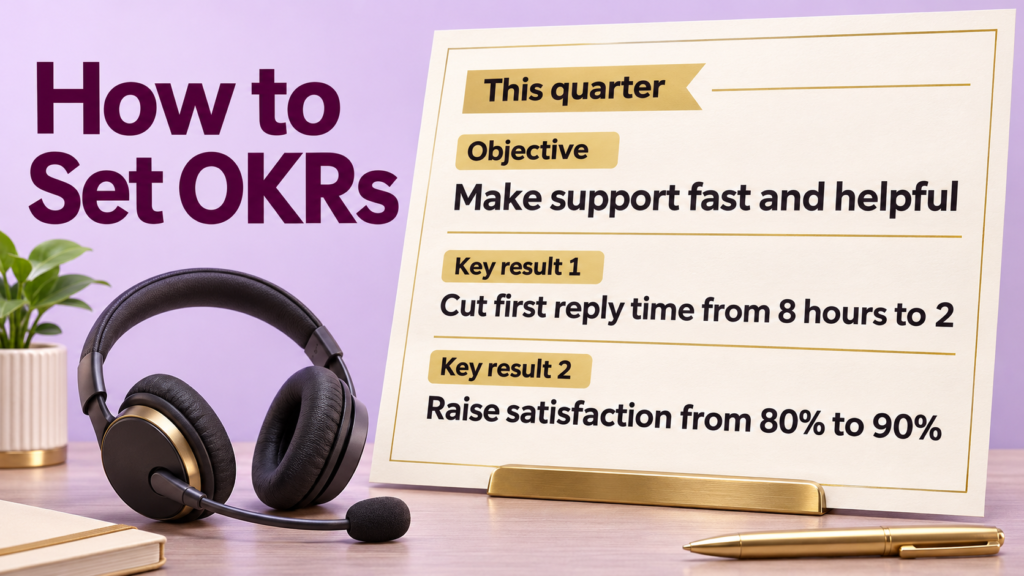
OKRs are a goal-setting framework made of two parts:
- Objective: a clear, qualitative description of what you want to achieve. It should be inspiring and meaningful.
- Key results: two to five measurable outcomes that show whether the objective has been achieved.
A simple formula often used to describe OKRs is: “I will achieve [objective] as measured by [key results].”
A Brief History of OKRs
OKRs grew out of Peter Drucker’s Management by Objectives approach from the 1950s. Andy Grove developed and popularized OKRs at Intel in the 1970s and documented the approach in his 1983 book High Output Management. John Doerr, who learned the system at Intel in the mid-1970s, introduced OKRs to Google in 1999 while working as a venture capitalist. The method spread widely across technology companies and later to organizations of all kinds, helped by Doerr’s book Measure What Matters.
Objectives Explained
Good objectives are:
- Qualitative and inspiring, using clear language.
- Important enough to deserve focus this period.
- Time-bound, usually for a quarter or year.
- Actionable by the team that owns them.
- Concise and memorable.
Examples of objectives include “Delight our first-time customers,” “Become the go-to supplier for local restaurants” or “Build a reliable, scalable platform.”
Key Results Explained
Key results turn the objective into measurable outcomes. Good key results are:
- Specific and quantifiable.
- Outcome-focused rather than task-focused.
- Challenging but achievable.
- Verifiable, with no grey area about whether they were achieved.
- Limited in number, typically three to five per objective.
For the objective “Delight our first-time customers,” key results might be: increase first-order satisfaction score from 80 to 90 percent, reduce delivery complaints by half and raise repeat purchase rate within 60 days from 20 to 30 percent.
Key Results Versus Tasks
A common mistake is writing tasks as key results. “Launch a new onboarding email series” is a task or initiative. The key result is the outcome the task is meant to achieve, such as “increase 30-day retention from 40 to 55 percent.” Initiatives are the projects and actions teams undertake to move key results.
OKRs Versus KPIs
| Aspect | OKRs | KPIs |
|---|---|---|
| Purpose | Drive change and ambitious improvement | Monitor ongoing health and performance |
| Time frame | Usually quarterly or annual | Continuous |
| Structure | Objective plus measurable key results | Individual metrics with targets |
| Ambition | Often stretch goals | Usually realistic thresholds |
| Example | Become customers’ favorite support team, measured by satisfaction and response time improvements | Average support response time |
KPIs and OKRs work together. KPIs show whether the business is healthy; OKRs focus effort on improving specific areas, sometimes by moving a KPI significantly.
How to Write Strong OKRs Step by Step
Step 1: Start With Strategy
OKRs should connect to the organization’s mission, vision and strategic priorities. Ask: what are the most important things we must achieve this period to move our strategy forward?
Step 2: Draft a Few Objectives
Choose a small number of objectives, often three to five at company level. Too many objectives dilute focus.
Step 3: Define Key Results
For each objective, write measurable key results. Include a baseline and a target, such as “from 12 to 20.”
Step 4: Check Quality
Test each OKR: is it clear, measurable, ambitious, outcome-focused and owned by someone?
Step 5: Align Across Teams
Teams create their own OKRs that support company objectives, while also proposing ideas upward.
Step 6: Plan Initiatives
List the projects and actions teams will pursue to achieve their key results.
Step 7: Communicate
Share OKRs openly so everyone can see priorities and how their work fits.
OKR Examples for Different Teams
Sales
- Objective: Expand our presence with mid-sized business customers.
- Key results: sign 25 new mid-sized accounts, increase average contract value from 8,000 to 10,000 dollars, raise win rate from 20 to 28 percent.
Marketing
- Objective: Make our brand the first choice for local homeowners.
- Key results: grow qualified leads from 300 to 450 per month, improve website conversion from 2 to 3 percent, increase review rating from 4.3 to 4.6.
Operations
- Objective: Deliver orders faster and more reliably.
- Key results: cut average delivery time from five days to three, reduce order errors below 1 percent, raise on-time delivery to 97 percent.
People and Culture
- Objective: Make our company a great place to grow a career.
- Key results: raise employee engagement score from 68 to 75, reduce voluntary turnover from 18 to 12 percent, provide training plans for 100 percent of staff.
Committed Versus Aspirational OKRs
Many organizations distinguish two types:
- Committed OKRs: goals the team expects to fully achieve, such as meeting a launch date.
- Aspirational or stretch OKRs: ambitious goals where achieving around 70 percent may be considered success.
Labeling OKRs clearly prevents confusion about expectations.
Scoring OKRs
At the end of each cycle, teams score key results. A common approach uses a scale from 0 to 1.0:
- 0.0 to 0.3: little progress.
- 0.4 to 0.6: meaningful progress but short of target.
- 0.7 to 1.0: target largely or fully achieved.
Scoring is a learning tool. Teams discuss what worked, what did not and what to change next cycle.
Regular Check-Ins
OKRs work best when reviewed regularly, often weekly or every two weeks within teams. Check-ins cover progress on key results, confidence levels, obstacles and adjustments to initiatives. Monthly or mid-quarter reviews at leadership level ensure alignment.
Rolling Out OKRs in an Organization
- Start with leadership OKRs and a pilot team.
- Train managers and staff on writing good OKRs.
- Keep the process simple at first; spreadsheets work fine.
- Expect a learning curve over the first few cycles.
- Gather feedback and refine the approach.
- Consider dedicated OKR software once the practice matures.
OKRs for Small Businesses
Small businesses can benefit from OKRs without heavy processes. An owner and team might set two or three quarterly objectives, such as improving cash flow, growing repeat customers or launching a new service. A one-page OKR sheet reviewed in weekly team meetings can create focus and accountability. Key results tied to cash collection, profit margins and customer retention are especially helpful for small firms.
OKRs and Performance Reviews
Many OKR advocates recommend separating OKR scores from compensation decisions. Tying bonuses directly to OKR achievement can encourage people to set easy goals. Instead, organizations often use OKRs to guide work and learning, while performance reviews consider broader contributions, behaviors and results.
Tips for Effective OKRs
- Keep the number of OKRs small.
- Write objectives in plain, motivating language.
- Make key results measurable with baselines and targets.
- Assign a single owner to each OKR.
- Make OKRs visible to everyone.
- Review progress frequently.
- Learn from each cycle and improve.
Common OKR Mistakes
- Too many objectives and key results.
- Writing tasks instead of outcomes.
- Setting key results without baselines.
- Making every OKR a stretch goal, or none at all.
- Setting OKRs and never reviewing them.
- Cascading OKRs rigidly from the top without team input.
- Linking OKRs directly to bonuses, encouraging sandbagging.
Writing OKRs Together as a Team
OKRs work best when the people doing the work help create them. A simple OKR planning session might follow these steps:
- Leaders share company priorities and context for the coming quarter.
- Teams review results from the previous cycle and lessons learned.
- Each team drafts objectives that support company priorities.
- Teams propose key results with baselines and targets.
- Leaders and teams review drafts together to check alignment and ambition.
- Final OKRs are published where everyone can see them.
This mix of top-down direction and bottom-up input builds commitment and surfaces ideas leaders might miss.
Before and After: Improving a Weak OKR
Consider a weak OKR: “Objective: Improve marketing. Key results: post on social media daily, redesign the website, run more ads.” The objective is vague, and the key results are tasks.
An improved version might read: “Objective: Become the most trusted name for home repairs in our city. Key results: grow monthly qualified leads from 200 to 320, increase website conversion from 2.5 to 4 percent, and raise average online review score from 4.2 to 4.6.” Posting daily and redesigning the website become initiatives that support these results.
OKRs Beyond Business
Nonprofits, schools and government agencies also use OKRs. A nonprofit might set an objective to expand access to its programs, with key results tied to participants served, volunteer hours and donor retention. The framework adapts well because it focuses on clear goals and measurable outcomes rather than profit alone.
Tools for Tracking OKRs
Many teams begin with a shared spreadsheet or document listing objectives, key results, owners, baselines, targets and current progress. As programs grow, dedicated OKR software can automate updates, show alignment between teams and integrate with project management tools. Whatever the tool, visibility and regular updates matter more than features.
Signs Your OKR Program Is Working
- Teams can explain how their work connects to company objectives.
- Weekly conversations focus on progress and obstacles rather than activity lists.
- Leaders use OKR data to reallocate resources during the quarter.
- Each cycle’s lessons improve the next set of OKRs.
If these signs are missing after two or three cycles, simplify the process and revisit training.
Ending a Cycle Well
Close each cycle with a short retrospective. Score every key result, discuss surprises, note which initiatives moved results and decide which objectives continue into the next quarter. Celebrate progress publicly to keep motivation high.
Final Thoughts
OKRs give organizations a simple, powerful way to translate strategy into focused, measurable goals. Each objective describes what matters, and each set of key results defines how success will be measured. Originating with Andy Grove at Intel and popularized by John Doerr after he introduced them to Google in 1999, OKRs now help teams of all sizes align efforts and track progress. Strong OKRs are few, clear, outcome-focused and ambitious, with baselines, targets and owners. Regular check-ins, honest scoring and learning between cycles make them effective. Keep the process simple, separate OKRs from compensation and use them to drive meaningful progress.
Frequently Asked Questions
1. How many OKRs should a team have?
Many teams use about three to five objectives per cycle, each with two to five key results, to keep focus manageable.
2. How often should OKRs be set?
Many organizations set OKRs quarterly, with some annual company-level objectives, and review progress weekly or every two weeks.
3. What is a good OKR score?
For stretch goals, scores around 0.6 to 0.7 are often considered strong. Committed OKRs are expected to be fully achieved.