Many products fail not because they are poorly made, but because customers do not care enough to buy them. Businesses often fall in love with features, technology or ideas without confirming that they solve real problems. Value proposition design tackles this challenge directly. It helps organizations understand what customers are trying to achieve, what frustrates them and what would delight them, then design products and services that fit those needs.
This guide covers value proposition design basics. It explains what a value proposition is, the Value Proposition Canvas, customer jobs, pains and gains, products and services, pain relievers and gain creators, achieving fit, how to research customers, writing value proposition statements, testing ideas, examples, B2B considerations, communicating value, common mistakes and tips.
Table of Contents
What a Value Proposition Is
A value proposition describes the benefits customers can expect from a product or service and why they should choose it over alternatives. A strong value proposition is:
- Customer-focused: it addresses specific needs or problems.
- Clear: customers quickly understand what they get.
- Differentiated: it explains why it is better or different from alternatives.
- Credible: claims can be backed by evidence.
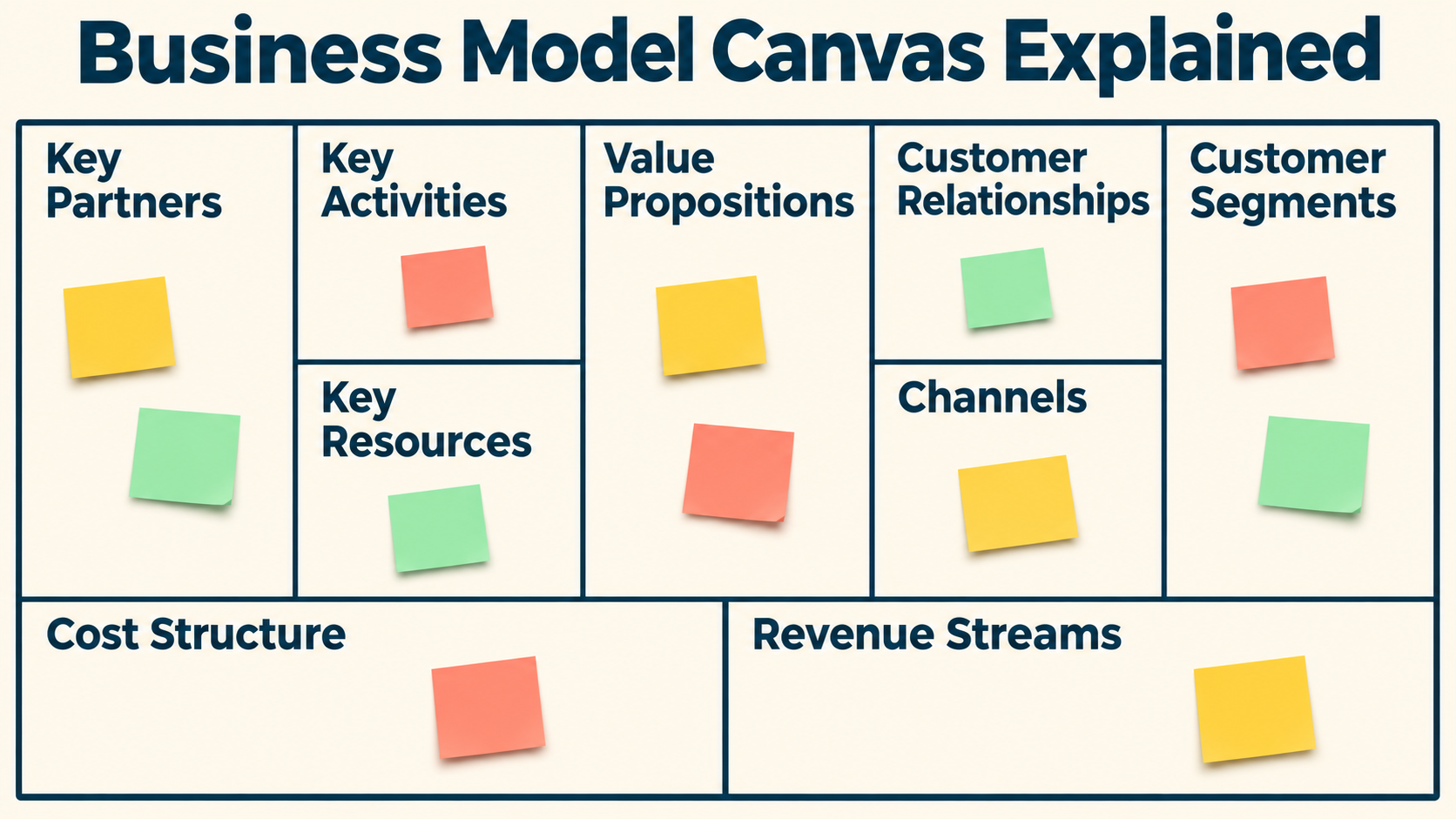
The value proposition is one of the nine building blocks of the Business Model Canvas and sits at the heart of business strategy.
The Value Proposition Canvas
The Value Proposition Canvas was developed by Alexander Osterwalder and colleagues as a companion to the Business Model Canvas. It was presented in the book Value Proposition Design, released in 2014. The canvas has two sides:
- Customer profile: describes a specific customer segment through jobs, pains and gains.
- Value map: describes how products and services create value through pain relievers and gain creators.
The goal is to achieve fit, where the value map matches what matters most in the customer profile.
Customer Jobs
Customer jobs are the tasks customers are trying to complete, problems they are trying to solve or needs they want to satisfy. Jobs can be:
- Functional: practical tasks, such as preparing dinner or filing taxes.
- Social: how customers want to be seen by others, such as appearing professional.
- Emotional: how customers want to feel, such as secure or confident.
- Supporting: related jobs, such as comparing options before buying.
Understanding jobs shifts focus from products to customer goals.
Customer Pains
Pains are negative experiences, risks and obstacles related to customer jobs. Examples include:
- Undesired outcomes, such as poor results or wasted money.
- Obstacles, such as lack of time or skills.
- Risks, such as financial loss, embarrassment or safety concerns.
- Frustrations, such as complicated processes or poor service.
Ranking pains by severity helps identify which problems matter most.
Customer Gains
Gains are outcomes and benefits customers want. They can be:
- Required gains: basic expectations without which a solution would not work.
- Expected gains: benefits customers expect even if not essential.
- Desired gains: benefits customers would love but do not necessarily expect.
- Unexpected gains: benefits that go beyond expectations and delight customers.
Products and Services
On the value map, list the products and services the value proposition is built around. These can be physical products, digital offerings, services or financial products. Not all are equally important to customers, so prioritize them.
Pain Relievers
Pain relievers describe how products and services reduce or eliminate customer pains. For example, a scheduling app might eliminate double bookings, reduce time spent coordinating appointments and send automatic reminders to cut no-shows.
Gain Creators
Gain creators describe how products and services produce benefits customers want. The scheduling app might create gains by increasing revenue through fewer missed appointments, giving business owners more free time and providing insights into busy periods.
Customer Profile and Value Map Compared
| Customer Profile Element | Matching Value Map Element | Question to Ask |
|---|---|---|
| Customer jobs | Products and services | Which jobs do our offerings help customers complete? |
| Pains | Pain relievers | How do we reduce or remove the biggest frustrations and risks? |
| Gains | Gain creators | How do we produce the outcomes customers want most? |
Achieving Fit
Osterwalder and colleagues describe three levels of fit:
- Problem-solution fit: evidence that customers care about certain jobs, pains and gains, and that your value proposition addresses them, at least on paper.
- Product-market fit: evidence that customers actually value and buy the product.
- Business model fit: evidence that the value proposition can be delivered profitably within a sustainable business model.
Researching Customers
Good value propositions start with customer understanding. Research methods include:
- Customer interviews focused on their experiences, not your product.
- Observation of customers performing jobs.
- Surveys to quantify pains and gains.
- Reviewing support tickets, reviews and complaints.
- Analyzing sales data and lost deals.
- Studying how customers use competitor products.
Ask open questions such as “Tell me about the last time you tried to…” rather than “Would you buy a product that…?” People are better at describing past behavior than predicting future choices.
Writing a Value Proposition Statement
A simple template can help:
- “Our [product or service] helps [customer segment] who want to [job] by [reducing pain] and [creating gain], unlike [competing alternative].”
For example: “Our scheduling app helps small salon owners who want to fill their calendars by cutting no-shows with automatic reminders and saving hours of phone time, unlike paper appointment books.”
Refine statements until they are concise, specific and easy to understand.
Testing Value Propositions
Value proposition ideas are hypotheses until tested. Testing methods include:
- Landing pages that describe the value proposition and measure sign-ups.
- Prototypes or mockups shown to potential customers.
- Minimum viable products with core features.
- Pre-sales or deposits to measure willingness to pay.
- A/B testing different messages in advertising.
- Pilot programs with a small group of customers.
Measure real behavior, such as sign-ups or purchases, rather than relying only on positive feedback.
A Fictional Example: Home Insurance Comparison Service
- Customer jobs: protect their home and belongings, find affordable coverage, understand policy options.
- Pains: confusing policy language, time-consuming quotes, fear of being underinsured after storms.
- Gains: confidence in coverage, savings on premiums, quick and simple process.
- Products and services: online comparison tool, plain-language policy summaries, licensed advisor support.
- Pain relievers: single form for multiple quotes, clear explanations of deductibles and exclusions.
- Gain creators: personalized coverage recommendations, alerts about discounts and renewal reminders.
Such a service would also need to comply with insurance licensing and consumer protection rules in each market it serves.
Value Propositions in B2B Markets
In business-to-business sales, multiple people influence purchases, such as users, managers, finance teams and procurement. Each may have different jobs, pains and gains. A strong B2B value proposition often focuses on measurable outcomes, such as cost savings, revenue growth, risk reduction, compliance and productivity, and may require return-on-investment calculations to support decisions.
Communicating Value
- Lead with the main benefit in headlines and sales conversations.
- Use customer language rather than internal jargon.
- Support claims with evidence, such as testimonials, case studies and data.
- Highlight differentiation clearly.
- Keep messages consistent across websites, advertising and sales materials.
Avoid exaggerated or misleading claims, which can damage trust and may violate advertising rules.
Practical Tips
- Create separate canvases for different customer segments.
- Focus on the most important jobs, pains and gains.
- Involve sales and support teams, who hear customer feedback daily.
- Revisit value propositions as customer needs and competitors change.
- Link value proposition work to pricing decisions.
- Test before investing heavily.
Common Mistakes
- Starting with features instead of customer needs.
- Mixing multiple segments in one canvas.
- Listing every possible pain and gain without prioritizing.
- Assuming customers value what the team values.
- Relying on opinions instead of evidence.
- Writing vague value statements, such as “high quality and great service.”
- Failing to update value propositions over time.
Running a Value Proposition Workshop
Teams often design value propositions together in a workshop. A simple format includes:
- Choosing one customer segment to focus on.
- Sharing research findings, such as interview quotes and survey results.
- Filling in customer jobs, pains and gains on sticky notes.
- Ranking pains and gains by importance.
- Brainstorming products, pain relievers and gain creators.
- Checking which top pains and gains are addressed and which are not.
- Selecting the riskiest assumptions to test first.
Repeating the exercise for each major segment reveals where offers need to differ.
Linking Value Propositions to Pricing
A clear value proposition supports value-based pricing. When customers understand how much time, money or risk a product saves, they are more willing to pay a premium. Quantifying value, for example by showing average savings or revenue gains, strengthens pricing conversations, especially in business markets.
Questions for Customer Interviews
- What were you trying to accomplish the last time you faced this problem?
- What made it difficult or frustrating?
- What solutions have you tried, and what did you like or dislike?
- What would the ideal outcome look like?
- How much time or money does this problem cost you today?
Listening carefully to answers, and asking follow-up questions about specific examples, reveals jobs, pains and gains far better than asking customers to evaluate your idea directly.
Value Propositions for Different Segments
Most businesses serve more than one customer segment, and each may need its own value proposition. A software company might emphasize ease of use for small businesses, integration and security for large enterprises and affordability for nonprofits. Creating separate canvases for each segment helps tailor products, pricing and messaging rather than relying on a single generic promise.
Measuring Value Proposition Success
Track conversion rates on landing pages and sales calls, win rates against competitors, customer retention, net promoter scores and the price premium customers accept. Improvements in these measures suggest the value proposition resonates; declines may signal that customer needs or competitors have changed.
Updating Value Propositions Over Time
Customer needs evolve with technology, regulation and competition. Review canvases at least once a year, refresh customer research and retire claims that no longer differentiate. Value propositions that stay current keep products relevant and pricing strong.
Final Thoughts
Value proposition design helps businesses create products and services customers genuinely want. The Value Proposition Canvas, presented by Alexander Osterwalder and colleagues in the 2014 book Value Proposition Design, pairs a customer profile of jobs, pains and gains with a value map of products, pain relievers and gain creators. The aim is fit: first between problems and solutions, then between products and markets, and finally within a profitable business model. Strong value propositions come from deep customer research, clear and specific statements, rigorous testing and honest communication. By focusing on what customers need rather than what businesses want to sell, organizations improve their chances of building offerings that succeed.
Frequently Asked Questions
1. What is a value proposition?
A value proposition describes the benefits a product or service delivers to customers and why they should choose it over alternatives.
2. What are customer jobs, pains and gains?
Jobs are what customers are trying to achieve, pains are obstacles and risks they face, and gains are outcomes and benefits they want.
3. How is the Value Proposition Canvas related to the Business Model Canvas?
The Value Proposition Canvas zooms into the customer segments and value propositions blocks of the Business Model Canvas to design and test customer fit in more detail.