Most businesses spend their energy fighting rivals for the same customers, matching features, cutting prices and spending more on marketing just to hold their ground. Blue Ocean Strategy offers a different idea: instead of competing harder in crowded markets, create new market space where competition becomes irrelevant. The concept has become one of the most popular strategy frameworks of the past two decades, taught in business schools and used by companies, governments and nonprofits.
This guide explains Blue Ocean Strategy in practical terms. It covers the origins of the idea, red oceans versus blue oceans, value innovation, the strategy canvas, the four actions framework, the ERRC grid, the six paths to new market space, non-customers, the strategic sequence, implementation principles, examples, criticisms and common mistakes.
Table of Contents
Where Blue Ocean Strategy Came From
Blue Ocean Strategy was developed by W. Chan Kim and Renée Mauborgne, professors of strategy at INSEAD, the international business school. They introduced the ideas in an October 2004 Harvard Business Review article and expanded them in the book Blue Ocean Strategy, first published in the mid-2000s and later released in an expanded edition in 2015. Their research examined strategic moves across many industries over long periods to understand how companies created new markets.
Red Oceans Versus Blue Oceans
Kim and Mauborgne use two metaphors:
- Red oceans represent existing industries with known boundaries and rules. Companies compete for a share of existing demand. As competition intensifies, profits and growth shrink and the water turns red.
- Blue oceans represent untapped market space, new demand and opportunities for profitable growth. Competition is irrelevant because the rules have not yet been set.
| Red Ocean Strategy | Blue Ocean Strategy |
|---|---|
| Compete in existing market space | Create uncontested market space |
| Beat the competition | Make the competition irrelevant |
| Exploit existing demand | Create and capture new demand |
| Make the value-cost trade-off | Break the value-cost trade-off |
| Choose differentiation or low cost | Pursue differentiation and low cost together |
Value Innovation: The Core Idea
The cornerstone of Blue Ocean Strategy is value innovation, the simultaneous pursuit of differentiation and low cost. Traditional strategy often assumes companies must choose between offering more value at higher cost or reasonable value at lower cost. Value innovation challenges that trade-off by eliminating and reducing factors that customers do not value much while raising and creating factors they do. This lowers costs and increases value at the same time.
Value innovation is not the same as technology innovation. A blue ocean can be created with existing technologies arranged in a new way that offers a leap in value for buyers.
The Classic Example: Reinventing the Circus
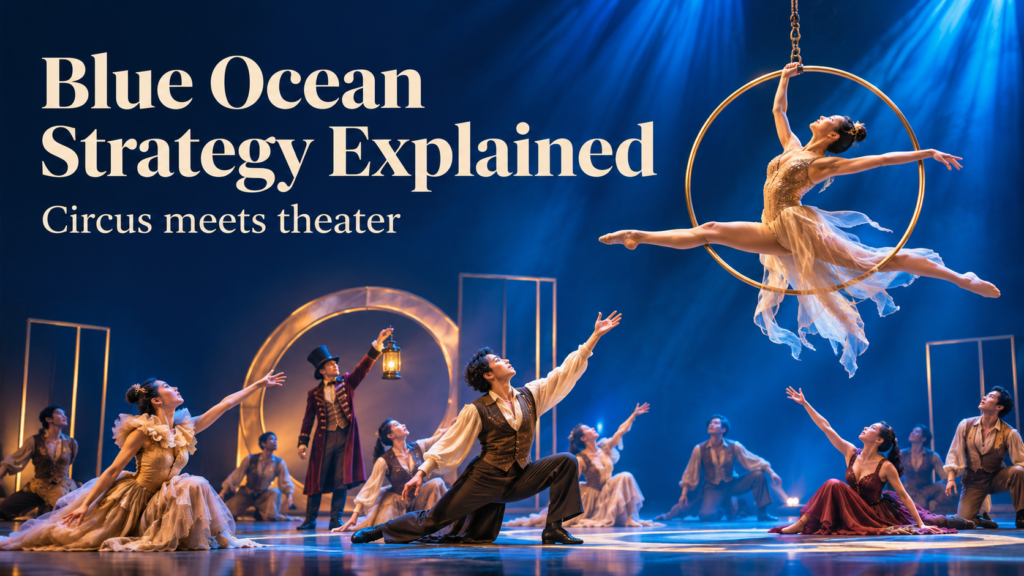
The best-known example in Kim and Mauborgne’s work is Cirque du Soleil. Founded in 1984 by street performers, it entered an industry many considered in long-term decline. Instead of competing with traditional circuses on star performers and animal acts, it eliminated costly elements such as animal shows, reduced others and added theatrical features like storylines, artistic music and dance. It attracted a new audience of adults and corporate clients willing to pay theater-level prices. According to the authors, within about 20 years it reached revenues that the world’s leading traditional circus took more than a century to achieve.
The Strategy Canvas
The strategy canvas is a visual tool that shows how an industry competes. The horizontal axis lists key factors the industry competes on, such as price, features, service and convenience. The vertical axis shows the level of offering buyers receive for each factor. Plotting a line for each competitor creates a value curve.
In red oceans, value curves often look similar because companies benchmark against each other. A blue ocean strategy produces a value curve that diverges sharply, focusing on different factors.
The Four Actions Framework
To create a new value curve, the four actions framework asks four questions:
- Eliminate: which factors that the industry takes for granted should be eliminated?
- Reduce: which factors should be reduced well below the industry’s standard?
- Raise: which factors should be raised well above the industry’s standard?
- Create: which factors should be created that the industry has never offered?
Eliminating and reducing help lower costs. Raising and creating help increase buyer value.
The ERRC Grid
The Eliminate-Reduce-Raise-Create grid is a practical worksheet for applying the four actions. Teams list specific factors under each heading. For example, a fictional budget hotel might:
- Eliminate: restaurants, large lobbies and room service.
- Reduce: room size and furniture options.
- Raise: bed quality, cleanliness and soundproofing.
- Create: fully automated check-in and late-night healthy snack stations.
The result could be lower operating costs and a sharply focused offer for travelers who mainly want a great night’s sleep at a fair price.
Six Paths to New Market Space
Kim and Mauborgne suggest six ways to look across boundaries to find blue oceans:
- Look across alternative industries: consider products that serve the same purpose in different forms.
- Look across strategic groups: examine why customers trade up or down between groups within an industry.
- Look across the chain of buyers: consider users, purchasers and influencers who may value different things.
- Look across complementary products and services: think about what happens before, during and after use.
- Look across functional or emotional appeal: shift an industry’s emphasis from function to emotion, or the reverse.
- Look across time: anticipate how trends will affect buyer value in the future.
Reaching Beyond Existing Demand: Non-Customers
Blue ocean thinking encourages companies to focus on non-customers rather than only existing customers. The authors describe three tiers:
- First tier: soon-to-be non-customers who use the industry’s offering minimally and are looking for better alternatives.
- Second tier: refusing non-customers who consciously choose not to use the industry’s offering.
- Third tier: unexplored non-customers who have never considered the industry’s offering.
Understanding why these groups do not buy can reveal large untapped markets.
Getting the Strategic Sequence Right
A blue ocean idea must be commercially viable. Kim and Mauborgne recommend checking ideas in sequence:
- Buyer utility: is there exceptional value for buyers?
- Price: is the price accessible to the mass of target buyers?
- Cost: can the company meet target costs and still profit?
- Adoption: have hurdles for employees, partners and the public been addressed?
Implementation Principles
The framework also addresses execution:
- Overcome key organizational hurdles: cognitive, resource, motivational and political obstacles.
- Tipping point leadership: focus resources on factors with disproportionate influence.
- Fair process: engage people, explain decisions and set clear expectations to build trust and commitment.
Applying Blue Ocean Thinking in a Small Business
- List the factors your industry competes on.
- Draw a simple strategy canvas comparing your business with two or three competitors.
- Interview non-customers about why they do not buy.
- Complete an ERRC grid with your team.
- Test the new offer on a small scale before investing heavily.
- Review pricing and cost structure to ensure profitability.
Before launching a new market offer, also consider legal and financial factors such as licensing, intellectual property protection, business insurance and financing for initial investment.
Criticisms and Limitations
- Blue oceans may not stay blue; successful ideas attract imitators.
- Some critics argue examples are chosen with hindsight.
- Creating new demand can be risky and expensive.
- Not every industry has obvious blue ocean opportunities.
- Execution often proves harder than the framework suggests.
Many strategists see blue ocean thinking as complementary to competitive analysis rather than a replacement for it.
Practical Tips
- Start with buyer value, not technology.
- Challenge industry assumptions openly.
- Use visuals like the strategy canvas to align teams.
- Involve people outside your industry for fresh perspectives.
- Prototype and test quickly with real customers.
- Plan how to defend your position as imitators appear.
Common Mistakes and Misconceptions
- “Blue ocean means inventing new technology.” Many blue oceans use existing technology in new ways.
- “It is only for large companies.” Small businesses can apply the tools too.
- “Adding features creates a blue ocean.” Without eliminating and reducing, costs rise.
- “Once in a blue ocean, competition disappears forever.” Imitation eventually arrives.
- “Focus on existing customers only.” Non-customers often hold the biggest opportunities.
- “Ignore pricing until later.” Strategic pricing is part of the sequence.
Blue Ocean Questions for Your Team
- What factors does our industry compete on that customers barely notice?
- Why do some people refuse to buy from anyone in our industry?
- What do buyers do before and after using our product that we could make easier?
- Could we shift our appeal from functional to emotional, or the reverse?
- Which trends will change what buyers value over the next five years?
Working through these questions in a strategy workshop often uncovers ideas that ordinary competitor benchmarking misses.
Measuring a Blue Ocean Move
Once a new offer launches, track indicators that show whether it is creating new demand rather than stealing share from rivals: the proportion of customers who were previously non-customers, growth in total market size, price realization compared with plan, unit costs against targets and how quickly imitators appear. These measures help leaders decide whether to scale the idea, adjust it or move on to the next opportunity.
Blue Ocean Thinking Beyond Business
Kim and Mauborgne have applied the ideas to public sector and nonprofit settings as well, encouraging agencies and charities to rethink how they deliver value at lower cost. The same tools, especially the strategy canvas and the ERRC grid, can help any organization question long-standing assumptions about what its users truly need.
Red Ocean Strategies Still Matter
Kim and Mauborgne acknowledge that red oceans will always exist and that companies must compete well in them. Blue ocean moves complement, rather than replace, efficient operations, good customer service and sound pricing. Many organizations balance a core red ocean business with a portfolio of exploratory blue ocean initiatives.
Reviewing this portfolio regularly helps leaders decide where to invest next and when to scale a promising idea.
Final Thoughts
Blue Ocean Strategy, developed by INSEAD professors W. Chan Kim and Renée Mauborgne, encourages businesses to stop fighting over shrinking profits in crowded red oceans and instead create new demand in uncontested blue oceans. Its core idea, value innovation, pursues differentiation and low cost together by eliminating and reducing what customers value little while raising and creating what they value most. Tools like the strategy canvas, the four actions framework, the ERRC grid, the six paths and the focus on non-customers make the approach practical. Blue oceans do not stay uncontested forever, and execution takes effort, but the framework remains a powerful way to rethink where and how to compete.
Frequently Asked Questions
1. Who created Blue Ocean Strategy?
Blue Ocean Strategy was developed by W. Chan Kim and Renée Mauborgne, professors of strategy at INSEAD, who introduced it in a 2004 Harvard Business Review article and a bestselling book.
2. What is value innovation?
Value innovation is the simultaneous pursuit of differentiation and low cost, creating a leap in value for buyers and the company while making competition less relevant.
3. What is the ERRC grid?
The ERRC grid lists which industry factors to eliminate, reduce, raise and create in order to build a new value curve and a distinctive offering.