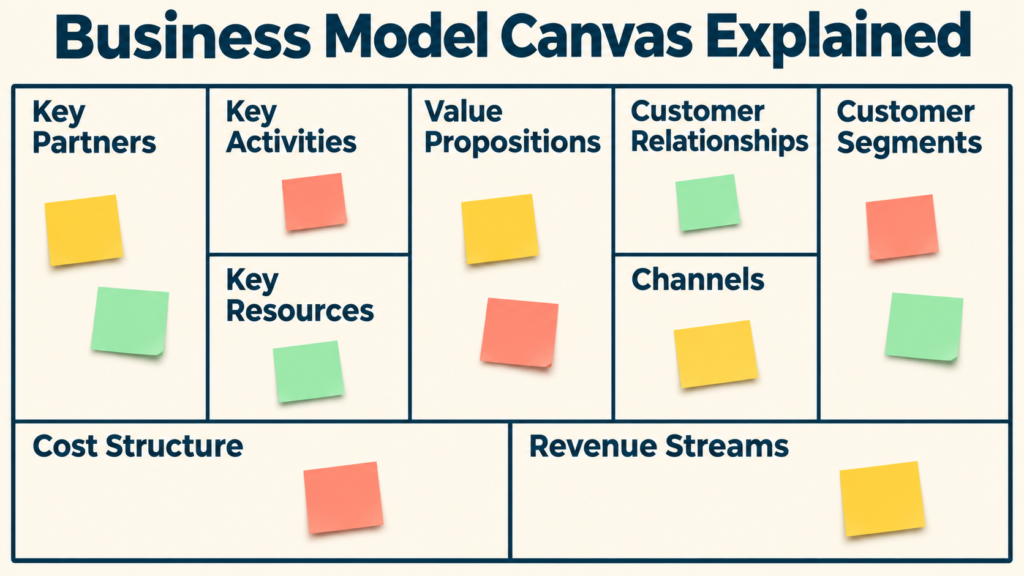
Every business has a business model, whether it is written down or not. It describes how the organization creates value for customers, delivers that value and earns money in return. Traditional business plans often describe this in dozens of pages. The Business Model Canvas captures it on a single page, using nine building blocks that make it easy to see how all the pieces fit together, spot weaknesses and test new ideas.
This guide explains the Business Model Canvas in detail. It covers its origins, the nine building blocks, how the blocks connect, how to fill in a canvas step by step, examples, using the canvas for startups and established businesses, testing assumptions, related tools such as the Value Proposition Canvas and Lean Canvas, facilitating canvas workshops, limitations and common mistakes.
Table of Contents
Where the Business Model Canvas Came From
The Business Model Canvas was developed by Swiss business theorist Alexander Osterwalder, building on his doctoral research on business model ontology at the University of Lausanne, completed in 2004. Together with his supervisor Yves Pigneur and hundreds of co-creators, he published the book Business Model Generation in 2010, which popularized the canvas worldwide. The tool is now taught in business schools and used by startups, corporations, nonprofits and governments.
The Nine Building Blocks
The canvas is divided into nine blocks. The right side focuses on customers and value, while the left side focuses on operations and efficiency.
1. Customer Segments
Who are you creating value for? Customer segments are groups of people or organizations with similar needs, behaviors or characteristics. Businesses may serve a mass market, niche markets, multiple segments or multi-sided platforms that connect different groups.
2. Value Propositions
What value do you deliver to each segment? A value proposition is the bundle of products and services that solves customer problems or satisfies needs. Value can come from newness, performance, customization, design, price, convenience, risk reduction, accessibility or brand status.
3. Channels
How do you reach customers and deliver value? Channels include sales, distribution and communication methods, such as stores, websites, apps, sales teams, partners and social media. Channels cover awareness, evaluation, purchase, delivery and after-sales support.
4. Customer Relationships
What type of relationship does each segment expect? Options range from personal assistance and dedicated account managers to self-service, automated services, communities and co-creation.
5. Revenue Streams
How does the business earn money from each segment? Revenue streams include product sales, usage fees, subscriptions, licensing, advertising, brokerage commissions, rentals and leases. Pricing may be fixed or dynamic.
6. Key Resources
What assets are essential to deliver the value proposition? Key resources can be physical, such as facilities and equipment; intellectual, such as brands, patents and data; human, such as skilled staff; or financial, such as cash and credit lines.
7. Key Activities
What must the business do well to make the model work? Key activities may include production, problem solving for clients, platform management, marketing or supply chain coordination.
8. Key Partnerships
Who are the important partners and suppliers? Partnerships help businesses reduce risk, gain resources or perform activities more efficiently. They can include strategic alliances, joint ventures, supplier relationships and partnerships with competitors in some cases.
9. Cost Structure
What are the most important costs? Businesses may be cost-driven, focusing on minimizing costs, or value-driven, focusing on premium value. Costs include fixed costs, variable costs, economies of scale and economies of scope.
The Nine Blocks at a Glance
| Block | Key Question | Example Content |
|---|---|---|
| Customer segments | Who are our customers? | Busy parents, small retailers, hospitals |
| Value propositions | What value do we deliver? | Saves time, lowers costs, reduces risk |
| Channels | How do we reach them? | Website, app, retail partners, sales team |
| Customer relationships | How do we interact? | Self-service, personal support, community |
| Revenue streams | How do we earn money? | Subscriptions, product sales, fees |
| Key resources | What assets do we need? | Technology, brand, skilled staff |
| Key activities | What must we do well? | Production, marketing, platform management |
| Key partnerships | Who helps us? | Suppliers, logistics firms, technology partners |
| Cost structure | What are our main costs? | Salaries, rent, materials, marketing |
How the Blocks Connect
The canvas is powerful because it shows relationships. A change in one block affects others. For example, targeting a new customer segment may require a different value proposition, new channels and new partnerships, which in turn change costs and revenue streams. Reviewing these connections reveals whether a business model is coherent.
How to Fill In a Canvas Step by Step
- Print a large canvas or use a digital whiteboard.
- Start with customer segments and value propositions, since they drive everything else.
- Add channels and customer relationships for each segment.
- Define revenue streams.
- Fill in key resources, activities and partnerships needed to deliver value.
- Outline the cost structure.
- Use sticky notes so ideas can be moved and changed easily.
- Use different colors for different customer segments to show which elements relate to each.
- Review the canvas as a whole, looking for gaps and contradictions.
A Fictional Example: Meal Kit Service
- Customer segments: busy young professionals and families who want to cook at home.
- Value propositions: fresh ingredients and easy recipes delivered weekly, saving time on planning and shopping.
- Channels: website, mobile app, social media and delivery partners.
- Customer relationships: self-service ordering, automated reminders and an online cooking community.
- Revenue streams: weekly subscription fees and add-on purchases.
- Key resources: supply chain, kitchen facilities, recipe developers, app technology.
- Key activities: sourcing ingredients, packing kits, marketing, customer service.
- Key partnerships: farms, packaging suppliers, delivery companies.
- Cost structure: ingredients, packaging, delivery, marketing and staff costs.
Using the Canvas for Startups
Startups use the canvas to describe their initial business model and then test assumptions. Each block contains hypotheses, such as “busy parents will pay for weekly meal kits.” Founders test these through customer interviews, prototypes and small experiments, updating the canvas as they learn. Investors often appreciate a clear canvas because it shows how the business intends to make money.
Using the Canvas for Established Businesses
Established companies use the canvas to:
- Document their current business model.
- Identify weaknesses, such as dependence on a single channel.
- Explore new business models in response to disruption.
- Compare their model with competitors.
- Design new ventures or product lines.
Testing Business Model Assumptions
- Customer interviews to validate needs and willingness to pay.
- Landing pages to test interest in offers.
- Pilot programs in limited markets.
- Pre-orders or crowdfunding to test demand.
- Cost estimates from suppliers to validate assumptions.
Related Tools
- Value Proposition Canvas: zooms into the customer segments and value proposition blocks, mapping customer jobs, pains and gains against products, pain relievers and gain creators.
- Lean Canvas: an adaptation for startups that replaces some blocks with problem, solution, key metrics and unfair advantage.
- SWOT analysis: can be applied to each block to assess strengths and risks.
- Financial modeling: turns revenue and cost assumptions into projections.
Running a Canvas Workshop
- Invite people from different functions.
- Start by agreeing on the purpose, such as describing the current model or designing a new one.
- Work block by block, encouraging quick ideas on sticky notes.
- Discuss connections and contradictions.
- Create alternative canvases for different options.
- Identify the riskiest assumptions and plan tests.
Financial, Legal and Risk Considerations
When designing a business model, consider financing needs for key resources, tax treatment of revenue streams such as subscriptions or licensing, contracts with key partners, intellectual property protection and insurance for key activities, such as product liability, professional liability or cyber coverage for digital models.
Limitations of the Canvas
- It simplifies complex businesses into nine boxes.
- It does not directly address competition or the wider environment.
- It lacks detail on financial projections.
- It may not capture organizational culture or strategy execution.
Using it alongside tools like PESTLE, Five Forces and financial models provides a more complete view.
Common Mistakes
- Filling in blocks with vague statements.
- Starting with internal resources instead of customers.
- Treating the canvas as finished rather than a working document.
- Combining multiple segments without distinguishing them.
- Not testing assumptions.
- Ignoring how blocks affect each other.
Patterns of Business Models
Osterwalder and Pigneur described several common business model patterns that can inspire new ideas:
- Unbundling: separating customer relationship, product innovation and infrastructure businesses.
- Long tail: selling many niche products in small quantities, often online.
- Multi-sided platforms: connecting two or more groups, such as buyers and sellers.
- Free as a business model: offering something free to some users while others pay.
- Open business models: collaborating with outside partners to create and capture value.
Comparing your canvas with these patterns can reveal opportunities for new revenue streams or partnerships.
Comparing Current and Future Canvases
A useful exercise is to create two canvases: one describing the business model today and one describing the desired future model. Comparing them side by side highlights the changes required, such as new partnerships, different channels or new revenue streams. This gap analysis can become the basis for a transformation roadmap with clear initiatives, owners and timelines.
Questions to Challenge Your Canvas
- Which customer segment is most profitable, and are we serving it best?
- Could we earn revenue in a different way, such as subscriptions instead of one-time sales?
- Which key activities could partners perform more efficiently?
- Which costs could be reduced without harming the value proposition?
- What would a new competitor’s canvas look like if it wanted to disrupt us?
Canvas for Nonprofits
Nonprofits often adapt the canvas by separating beneficiaries, who receive value, from donors and funders, who provide revenue. Each group may need its own value proposition, channels and relationships. Mapping both sides helps nonprofits design sustainable funding models and clearer impact strategies.
Keeping the Canvas Current
Revisit the canvas whenever major changes occur, such as entering a new market, launching a product or facing a new competitor. Dating each version shows how the model has evolved and keeps teams aligned on how the business actually works today.
Final Thoughts
The Business Model Canvas, developed by Alexander Osterwalder and popularized through the 2010 book Business Model Generation, turns the complex question of how a business works into a clear, one-page picture. Its nine building blocks, covering customer segments, value propositions, channels, customer relationships, revenue streams, key resources, key activities, key partnerships and cost structure, show how value is created, delivered and captured. Startups use it to test ideas, while established firms use it to understand and reinvent their models. Treat the canvas as a living document, test its assumptions with real customers and combine it with other strategy tools for a complete view.
Frequently Asked Questions
1. What are the nine blocks of the Business Model Canvas?
They are customer segments, value propositions, channels, customer relationships, revenue streams, key resources, key activities, key partnerships and cost structure.
2. Who created the Business Model Canvas?
Alexander Osterwalder developed it based on his doctoral research and popularized it with Yves Pigneur in the 2010 book Business Model Generation.
3. What is the difference between the Business Model Canvas and Lean Canvas?
Lean Canvas adapts the original for startups, replacing some blocks with problem, solution, key metrics and unfair advantage to focus on early-stage uncertainty.