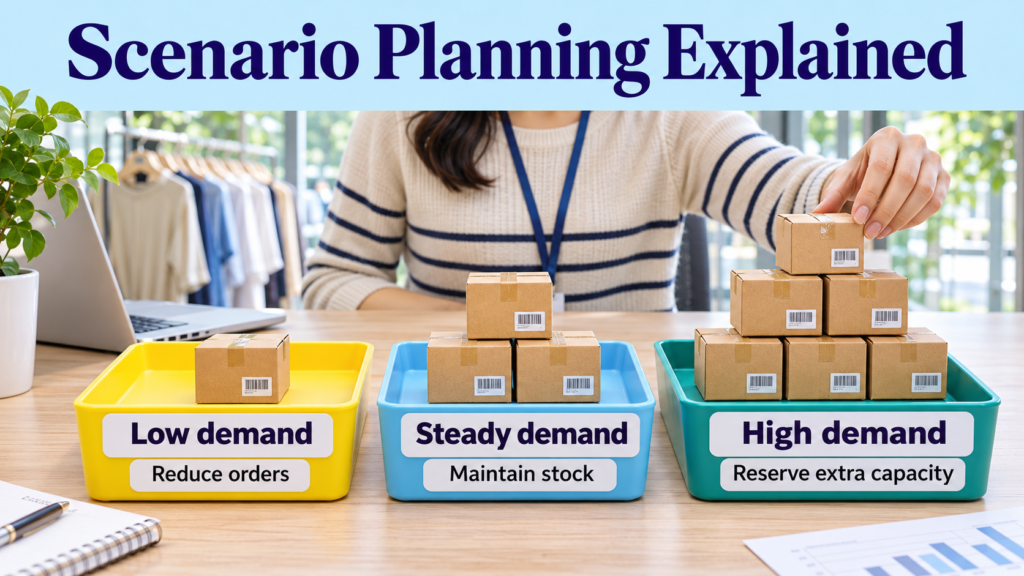
No one can predict the future, yet every strategy depends on assumptions about it. Will interest rates rise or fall? Will a new technology take off? Will regulations tighten? Will customers change how they buy? Traditional forecasting usually produces a single best guess, which works well when the world is stable and fails badly when it is not. Scenario planning takes a different approach. Instead of predicting one future, it explores several plausible futures and asks how the organization would succeed in each.
This guide explains scenario planning in practical terms. It covers what scenario planning is, how it differs from forecasting, its history, the benefits, the step-by-step process, how to identify driving forces and critical uncertainties, how to build a scenario matrix, how to write scenario stories, how to test strategies, early warning indicators, examples, scenario planning for small businesses, links to risk management and continuity planning, common challenges and mistakes.
Table of Contents
What Scenario Planning Is
Scenario planning is a strategic method that creates a small set of distinct, plausible stories about how the future might unfold. Each scenario describes a different combination of key uncertainties, such as economic conditions, technology adoption, regulation or customer behavior. Leaders then use these stories to test strategies, identify risks and opportunities, and prepare flexible responses.
Scenarios are not predictions. They are tools for thinking. The aim is to stretch mental models, challenge assumptions and help decision-makers recognize and respond to change faster than competitors.
Scenario Planning Versus Forecasting
| Aspect | Forecasting | Scenario Planning |
|---|---|---|
| Main output | One most likely future | Several plausible futures |
| Works best when | Conditions are stable and patterns repeat | Uncertainty is high and change is likely |
| Focus | Accuracy of prediction | Quality of preparation and decisions |
| Time horizon | Often short term | Often medium to long term |
| Risk | False confidence in a single number | Too many scenarios or vague stories |
| Typical use | Budgets, sales targets, inventory planning | Strategy, investment, risk and resilience planning |
Forecasting and scenario planning complement each other. Many organizations forecast for operational planning while using scenarios to test long-term strategy.
A Short History of Scenario Planning
Scenario thinking grew out of military and policy planning after World War II, including work associated with Herman Kahn at the RAND Corporation and later the Hudson Institute. In business, the oil company Royal Dutch Shell is widely credited with the first major commercial use. In the late 1960s and early 1970s, a planning team led by Pierre Wack developed scenarios that included the possibility that oil-producing nations would take control of supply and restrict production. When the 1973 oil crisis struck, Shell’s management was better prepared than many competitors. Wack later described the approach in Harvard Business Review articles in the 1980s, and scenario planning spread to governments, companies and nonprofits worldwide.
Why Scenario Planning Matters
- Better strategic decisions: strategies are tested against several futures, not just one.
- Faster response to change: leaders recognize early signs of a scenario unfolding.
- Reduced surprise: organizations explore uncomfortable possibilities in advance.
- Improved resilience: plans include flexibility and contingency options.
- Shared understanding: leaders develop a common language for discussing uncertainty.
- Smarter investments: capital decisions consider downside and upside cases.
- Stronger risk management: scenarios reveal combinations of risks that might otherwise be missed.
Lenders, investors and boards increasingly expect organizations to show how they would cope with different economic and market conditions, making scenario work valuable for financing and governance as well.
Step 1: Define the Focal Question and Time Horizon
Start by deciding what decision or issue the scenarios should inform. Examples include:
- Should we invest in a new factory over the next decade?
- How will our industry look in ten years?
- What will demand for our services be over the next five years?
- How should we prepare for changes in energy prices and regulation?
Choose a time horizon long enough for meaningful change but short enough to matter for decisions. Many business scenarios look three to ten years ahead, while some infrastructure and energy scenarios look decades ahead.
Step 2: Identify Driving Forces
Driving forces are trends and factors that could shape the future of the focal question. Tools such as PESTLE analysis help structure this step by looking at political, economic, social, technological, legal and environmental forces. Examples include:
- Economic growth, inflation and interest rates.
- Technological change, such as automation and artificial intelligence.
- Demographic shifts and changing customer preferences.
- Regulation, trade policy and geopolitics.
- Climate change and environmental policy.
- Competitive moves and new business models.
Gather input from internal experts, customers, suppliers, industry reports and external specialists to avoid blind spots.
Step 3: Separate Predetermined Elements From Uncertainties
Some driving forces are relatively predictable, such as an aging population in many countries. These predetermined elements appear in every scenario. Others are highly uncertain, such as the pace of technology adoption or the direction of regulation. Uncertainties are what make scenarios different from each other.
Step 4: Choose Critical Uncertainties
Rank uncertainties by two criteria: how much impact they would have on the focal question and how uncertain they are. The most important and most uncertain factors become the critical uncertainties. Many teams select two critical uncertainties to build a simple scenario matrix, though more complex approaches use more.
Step 5: Build the Scenario Framework
A common method is the two-by-two scenario matrix. Each axis represents one critical uncertainty with two extreme outcomes. For example, a regional hotel group might choose:
- Axis 1: travel demand, ranging from weak to strong.
- Axis 2: competition from short-term rental platforms, ranging from light regulation to heavy regulation.
This creates four scenarios, such as strong demand with heavy regulation of rentals, strong demand with light regulation, weak demand with heavy regulation and weak demand with light regulation. Each represents a distinct future the hotel group should consider.
Step 6: Write the Scenario Stories
Turn each quadrant into a vivid narrative describing how the world got there, what it looks like and what it means for the organization. Good scenarios:
- Have memorable names that capture their essence.
- Are internally consistent, with logical cause and effect.
- Are plausible, even if uncomfortable.
- Are clearly different from each other.
- Include specific details, such as customer behavior, prices and competitor actions.
- Avoid labeling one scenario as “best case” or “most likely,” which encourages people to ignore the others.
Step 7: Identify Implications
For each scenario, ask:
- What opportunities would emerge?
- What threats would we face?
- Which capabilities would matter most?
- How would customers, competitors and suppliers behave?
- What would happen to our revenue, costs and cash flow?
Financial modeling for each scenario helps quantify impacts and reveals whether the organization could survive severe downturns.
Step 8: Test and Develop Strategies
Evaluate current and proposed strategies against each scenario. Strategies fall into several categories:
- Robust strategies: perform reasonably well in all scenarios. These are often “no regret” moves.
- Scenario-specific strategies: work well in one or two scenarios but poorly in others. These may be held as options.
- Hedging strategies: reduce damage in unfavorable scenarios, such as diversifying suppliers or securing flexible financing.
- Big bets: high-risk strategies that pay off strongly in one future, which should be taken consciously.
Step 9: Set Early Warning Indicators
Identify signposts that show which scenario may be unfolding. Indicators might include interest rate changes, regulatory proposals, technology adoption rates, competitor investments or customer survey results. Monitor these regularly and agree in advance which actions to take when certain thresholds are reached.
Step 10: Embed Scenarios Into Planning
Scenario planning delivers the most value when integrated into strategy reviews, budgeting, investment decisions and risk management. Revisit scenarios periodically and update them as conditions change.
A Small Business Scenario Example
Consider a fictional regional construction company deciding whether to buy new equipment. Its critical uncertainties are interest rates and local housing demand. In a scenario of low rates and strong demand, buying equipment makes sense. In high rates and weak demand, leasing would protect cash flow. In mixed scenarios, a combination of buying core equipment and renting specialized machines works. The company decides to buy a small number of essential machines, lease others, secure a line of credit and track monthly housing permits and interest rates as early warning indicators.
Scenario Planning for Small Businesses
Small businesses do not need elaborate scenario exercises. A simple approach can be completed in a few hours:
- Choose one important decision.
- List the top uncertainties affecting it.
- Pick two and create four quick scenarios.
- Estimate revenue and cash flow in each.
- Identify actions that make sense in all scenarios.
- Set a few indicators to watch.
This exercise can reveal the need for cash reserves, flexible contracts, diversified customers or updated business insurance, such as business interruption coverage.
Scenario Planning, Risk Management and Continuity
Scenarios connect naturally to enterprise risk management and business continuity planning. While risk registers list individual risks, scenarios explore how multiple risks might combine. Continuity plans then prepare specific responses to disruptions such as supply chain failures, cyberattacks or natural disasters. Together, these practices build organizational resilience.
Running a Scenario Workshop
- Invite a diverse group, including people from different functions and outside perspectives.
- Share background research in advance.
- Use facilitated exercises to identify and rank driving forces.
- Build the scenario matrix together.
- Break into groups to draft scenario stories.
- Reconvene to discuss implications and strategies.
- Agree on indicators and next steps.
A full scenario process may take several workshops over weeks or months, while a simplified version can be done in a single day.
Common Challenges
- Leaders may want a single forecast and find multiple futures uncomfortable.
- Scenarios can become too complex or numerous to be useful.
- Teams may favor optimistic scenarios and dismiss unpleasant ones.
- Scenarios may be developed but not linked to decisions.
- Updating scenarios requires ongoing effort.
Practical Tips
- Keep the number of scenarios small, often three or four.
- Give scenarios memorable names.
- Include outside voices to challenge internal assumptions.
- Quantify key impacts where possible.
- Focus on decisions, not just stories.
- Revisit scenarios at least annually.
- Use scenarios to train leaders to think flexibly.
Common Mistakes
- Treating scenarios as predictions.
- Creating “good, bad and middle” scenarios based on one variable.
- Choosing uncertainties that are not truly critical.
- Writing vague scenarios without concrete details.
- Ignoring early warning indicators after the exercise.
- Failing to involve decision-makers.
Final Thoughts
Scenario planning helps organizations prepare for an uncertain future by exploring several plausible versions of it rather than betting on one forecast. Popularized in business by Shell’s planning team in the early 1970s, the method involves defining a focal question, identifying driving forces, selecting critical uncertainties, building distinct scenario stories, assessing implications and testing strategies across all futures. Robust strategies, hedges and early warning indicators turn scenarios into practical action. Whether used by large corporations or small businesses, scenario planning improves resilience, sharpens decisions and reduces the chance of being caught off guard when the world changes. Start simple and build the habit.
Frequently Asked Questions
1. What is the main purpose of scenario planning?
Its main purpose is to help organizations prepare for uncertainty by exploring several plausible futures and testing how strategies would perform in each, rather than relying on a single forecast.
2. How many scenarios should you create?
Many organizations use three or four scenarios, often built from two critical uncertainties in a two-by-two matrix, to keep the exercise manageable.
3. Which company made scenario planning famous?
Royal Dutch Shell is widely credited with popularizing scenario planning in business, after its planning team helped prepare management for the 1973 oil crisis.