Financial results tell leaders how an organisation performed last quarter. They say much less about whether it will perform well next year. A company can post strong profits while its culture quietly deteriorates, key people prepare to leave, managers burn out and customers start drifting to competitors. By the time these problems show up in the financial statements, they are much harder and more expensive to fix. Organisational health is the broader picture: the ability of an organisation to align around a clear direction, execute well, adapt to change and renew itself over time.
This guide explains what organisational health means, why it matters, the main dimensions to assess, the metrics and tools leaders can use, how to gather reliable data, how to interpret results and turn them into action, and how health connects to risk management, governance, insurance and long-term value. It also offers practical approaches for small and growing businesses.
Table of Contents
What Organisational Health Means
Organisational health is not a single number. It describes how well the organisation functions as a system. A healthy organisation typically has a clear and shared sense of direction, capable and trusted leadership, a culture that supports its strategy, effective processes, engaged employees, strong relationships with customers and partners and the ability to learn and adapt. An unhealthy organisation may still achieve short-term results but tends to struggle with misalignment, internal politics, high turnover, slow decisions and resistance to change.
Many consultancies and researchers have developed frameworks for measuring organisational health. They differ in terminology and emphasis but commonly cover direction, leadership, culture, accountability, coordination, capabilities, motivation, external orientation and innovation.
Why Health Matters as Much as Performance
Performance and health are related but distinct. Performance is what the organisation delivers now: revenue, profit, output, service levels. Health is its capacity to keep delivering in the future. Focusing only on performance can lead leaders to cut training, push employees too hard or neglect customer relationships to hit short-term targets, damaging health and future performance.
- Healthy organisations tend to attract and retain talent more easily
- They adapt faster to market changes and disruption
- They experience fewer costly failures in quality, safety and compliance
- They implement strategy more effectively because people are aligned
- They build resilience, recovering more quickly from setbacks
Key Dimensions to Assess
Direction and Strategy
Do people understand where the organisation is going and why? Can employees explain the main priorities and how their work contributes?
Leadership
Are leaders trusted, visible and effective? Do they communicate clearly, make timely decisions and support their teams?
Culture and Climate
Do shared values guide behaviour? Is the working environment respectful, inclusive and supportive of speaking up?
Accountability
Are roles and responsibilities clear? Do people take ownership of results, and are performance issues addressed fairly?
Coordination and Control
Do processes, systems and governance support efficient work? Are risks identified and managed?
Capabilities
Does the organisation have the skills and talent it needs now and for the future?
Motivation and Engagement
Are employees energised and committed? Do they feel valued and fairly rewarded?
External Orientation
How well does the organisation understand and respond to customers, competitors, regulators and communities?
Innovation and Learning
Does the organisation experiment, learn from mistakes and adapt?
Metrics That Signal Health
| Dimension | Example Metrics | Data Source | Warning Sign |
|---|---|---|---|
| Engagement | Engagement score, participation rate | Employee surveys | Falling scores or low participation |
| Retention | Voluntary turnover, regretted losses, early turnover | HR records | Rising departures of high performers |
| Wellbeing | Absence rates, stress indicators, overtime levels | HR and payroll data, surveys | Persistent overtime, rising sickness |
| Leadership | Trust in leadership, manager effectiveness ratings | Surveys, 360 feedback | Low confidence in decisions |
| Alignment | Understanding of strategy, goal completion rates | Surveys, planning systems | Teams unable to explain priorities |
| Capability | Internal promotion rate, skills gaps, training completion | HR systems, needs analysis | Heavy reliance on external hires for key roles |
| Customer orientation | Customer satisfaction, complaints, retention | Customer surveys, CRM data | Rising complaints or churn |
| Risk and compliance | Incidents, audit findings, near-miss reports | Risk and safety registers | Repeated findings, low reporting |
| Innovation | New ideas implemented, revenue from new offerings | Project records, finance | Few new initiatives reaching market |
Tools for Gathering Data
Employee Surveys
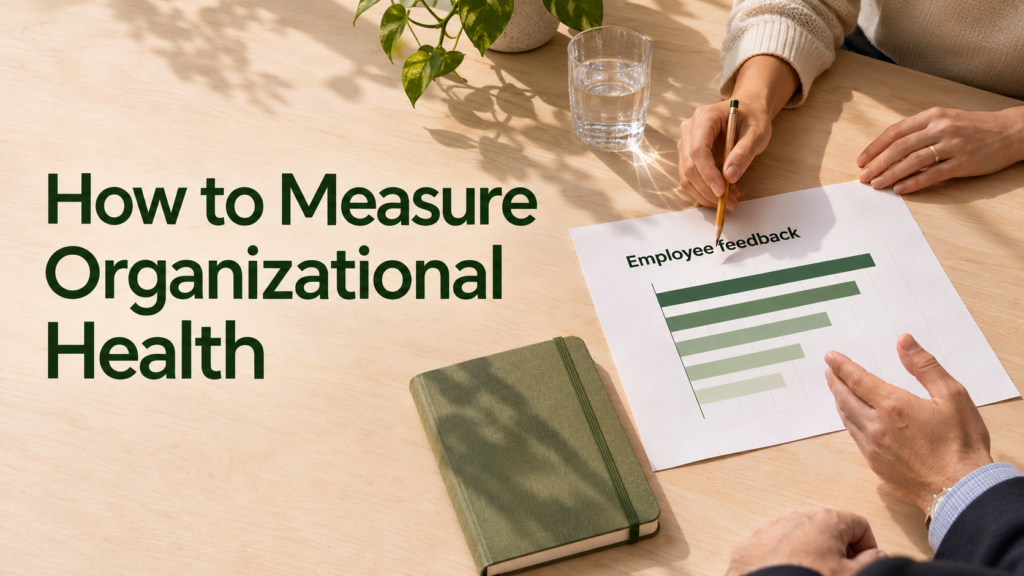
Annual engagement surveys provide broad insight, while shorter pulse surveys track changes more frequently. Use well-tested questions, guarantee confidentiality and report results only for groups large enough to protect anonymity.
Interviews and Focus Groups
Qualitative conversations reveal the stories behind the numbers. They help explain why scores are high or low and surface issues that surveys miss.
Operational and HR Data
Turnover, absence, overtime, promotion, training and performance data provide objective indicators. Combine them with survey results for a fuller picture.
Customer and Partner Feedback
Customers often notice internal problems before leaders do, for example through slower service or inconsistent quality.
Leadership Team Assessments
Senior teams can assess their own effectiveness, including trust, decision-making and alignment. External facilitators sometimes help leaders discuss sensitive issues honestly.
Making Data Reliable
Poorly designed measurement can mislead. Ensure surveys are confidential and that employees trust the process; if people fear consequences, they will give overly positive answers. Avoid survey fatigue by keeping questionnaires focused. Compare results over time and across groups rather than relying on single snapshots. Be cautious when comparing with external benchmarks, as differences in industry, culture and methodology can distort comparisons. Handle personal data in line with data protection laws, particularly when combining survey and HR data.
Interpreting Results
Look for patterns rather than reacting to individual scores. Which dimensions are strongest and weakest? Are there differences between departments, locations, levels or demographic groups? Do survey results align with operational data? For example, low engagement in one team combined with high turnover and absence suggests a serious issue that needs attention. Share results transparently with employees, including areas where the organisation is struggling.
Turning Insight Into Action
Measurement without action damages trust. After each assessment, choose a small number of priority areas to improve. Involve employees in designing solutions, assign clear owners and set timelines. Communicate what will change and report progress. Hold managers accountable for action plans in their teams, and provide them with support and resources.
- Pick two or three priority areas rather than trying to fix everything
- Co-design actions with the people affected
- Assign owners and deadlines
- Communicate progress regularly
- Re-measure to see whether actions worked
Health, Risk and Governance
Organisational health is closely linked to risk. Cultures where people fear speaking up hide problems that later become safety incidents, compliance breaches or fraud. High turnover in critical roles creates operational risk. Overstretched managers make more mistakes. Boards and investors increasingly look at culture and people metrics as part of governance, and some regulators expect firms in sectors such as financial services to monitor culture and conduct. Insurers may also consider indicators such as safety records, claims history and governance practices when assessing risk. Directors and officers may face greater scrutiny if they ignore clear warning signs about culture and conduct. Including health metrics in board reporting helps leaders meet these expectations.
Health and Business Value
For owners planning to sell, raise investment or borrow, organisational health can influence valuation. Buyers and investors often look beyond financial results to assess management depth, key person risk, employee turnover, culture and customer relationships. A business with strong health indicators and documented processes is often seen as less risky and more valuable than one that depends heavily on a few individuals.
A Fictional Example
Westbrook Engineering Group, a fictional firm with 500 employees, had strong profits but rising turnover among mid-level engineers and slowing project delivery. Leaders ran a health assessment combining a staff survey, focus groups and HR data. Results showed low scores on career development, recognition and cross-team coordination. The company introduced clearer career paths, a mentoring programme, quarterly recognition awards and a cross-functional project review process. Eighteen months later, voluntary turnover among engineers had fallen, internal promotions had increased and project delivery times had improved.
Measuring Health in Small Businesses
Small businesses can assess health without expensive tools. A short annual survey with ten to fifteen questions, regular one-to-one conversations, simple tracking of turnover and absence and periodic customer feedback provide valuable insight. Owners can also ask themselves whether the business could run smoothly for a month without them, which tests leadership depth and process maturity.
Questions Leaders Should Ask
- Can most employees explain our top priorities?
- Are our best people staying, and if not, why are they leaving?
- Do people feel safe raising problems and disagreeing?
- Are we developing future leaders internally?
- What do customers say about working with us compared with a year ago?
- Do we act on what employees tell us in surveys?
Tips for Measuring Organisational Health
- Combine survey data with operational and HR metrics
- Protect confidentiality to get honest responses
- Track trends over time rather than relying on single snapshots
- Share results openly, including weaknesses
- Focus on a few priority actions and follow through
- Include health metrics in leadership and board reporting
- Re-measure regularly to check whether actions are working
Common Mistakes and Misconceptions
- Assuming strong financial results mean the organisation is healthy
- Running surveys without acting on the results
- Relying on a single engagement score as the full picture
- Comparing with external benchmarks without understanding differences
- Reporting results in ways that compromise anonymity
- Treating health as an HR project rather than a leadership responsibility
- Measuring too often, causing survey fatigue
Building a Simple Health Dashboard
Leaders benefit from seeing a handful of health indicators alongside financial results each month or quarter. Choose around eight to twelve measures, such as voluntary turnover, absence, engagement pulse score, internal promotion rate, customer satisfaction and safety incidents, and present trends rather than single figures.
Final Thoughts
Organisational health is the foundation that sustains performance over the long term. Measuring it helps leaders spot problems early, before they show up as lost customers, departing talent, safety incidents or declining profits. A practical approach combines employee surveys, conversations, HR and operational data and customer feedback across dimensions such as direction, leadership, culture, accountability, capabilities, engagement and innovation. Make data reliable by protecting confidentiality and tracking trends over time. Most importantly, act on what you learn: choose a few priorities, involve employees in solutions and report progress. Healthy organisations are better at managing risk, meeting governance expectations and building lasting value. Treat health as a core leadership responsibility, review it regularly and it will strengthen every other part of the business.
Frequently Asked Questions
1. How often should organisational health be measured?
Many organisations run a comprehensive assessment once a year, supplemented by shorter pulse surveys every quarter or so. Operational metrics such as turnover and absence can be tracked monthly.
2. Is organisational health the same as employee engagement?
No. Engagement is one important part of health, but health is broader, covering leadership, strategy, processes, capabilities, customer orientation, risk management and innovation.
3. Who is responsible for organisational health?
Senior leaders own it, with support from HR and other functions. Managers at every level influence health through their daily behaviour, and boards increasingly oversee it as part of governance.