Teams make decisions all day long, from small choices about task priorities to major commitments about budgets, hiring, product launches or strategy. Yet few teams agree explicitly on how they will decide. Some default to whoever speaks loudest. Some try to reach full agreement on everything and end up stuck. Others leave every decision to the manager, who becomes a bottleneck. Choosing the right decision-making model for each situation makes teams faster, fairer and more committed to the choices they make.
This guide explains the main decision-making models teams use, when each works best, how to clarify decision rights, practical techniques for better group decisions, common biases that distort choices and how to document and review decisions. It also covers how decision processes connect to accountability, risk management, compliance and governance, especially for decisions with financial or legal consequences.
Table of Contents
Why Decision-Making Models Matter
When teams do not agree on how decisions are made, several problems follow. Meetings drag on because no one knows when discussion is over. People feel ignored when decisions are made without them, or frustrated when they are consulted on things that do not affect them. Decisions are revisited repeatedly because some team members never accepted them. Accountability blurs, so when outcomes disappoint, nobody owns the result. A clear model solves these problems by setting expectations about who decides, who contributes and how the final choice will be made.
Common Team Decision-Making Models
Command or Autocratic Decisions
The leader decides alone, sometimes with little or no input. This is fast and useful in emergencies, when safety is at stake or when the decision is routine and within the leader’s clear authority. Overused, it can reduce engagement and miss valuable knowledge held by team members.
Consultative Decisions
The leader gathers input from the team or experts, then makes the final call. This balances speed with inclusion. It works well for many everyday decisions, as long as people understand that their input will be considered but the leader decides. Leaders should explain the final decision and how input shaped it.
Democratic or Majority Vote
The team votes, and the option with the most support wins. Voting is quick and feels fair for some decisions, such as choosing a team event. However, it can leave a significant minority dissatisfied, and it may not suit complex decisions where expertise matters more than numbers.
Consensus Decisions
The team discusses until everyone can support the decision, even if it is not their first preference. Consensus builds strong commitment and surfaces concerns. It is slower and can be hijacked by one person blocking progress. It works best for important decisions where buy-in is essential and time allows.
Consent-Based Decisions
In consent-based models, a proposal moves forward unless someone raises a reasoned objection that it would cause harm or move the team backward. Rather than seeking everyone’s enthusiastic agreement, the question is whether anyone has a serious objection. This can be faster than consensus while still respecting concerns.
Delegated Decisions
The leader or team delegates the decision to an individual or subgroup with the most relevant expertise, within agreed limits. Delegation speeds up decisions and develops people, but it requires trust and clear boundaries.
Comparing Decision Models
| Model | Speed | Buy-In | Best For | Main Risk |
|---|---|---|---|---|
| Command | Very fast | Low to medium | Emergencies, routine matters, safety | Disengagement, missed insight |
| Consultative | Fast to medium | Medium to high | Most everyday business decisions | Input seen as token if ignored |
| Majority vote | Fast | Medium | Low-stakes choices with clear options | Unhappy minority, popularity over merit |
| Consensus | Slow | Very high | High-stakes decisions needing commitment | Deadlock, watered-down outcomes |
| Consent | Medium | High | Self-managing teams, policy changes | Objections not well reasoned |
| Delegated | Fast | Varies | Specialist decisions within clear limits | Unclear boundaries, poor oversight |
Matching the Model to the Situation
No single model fits every decision. Consider a few factors when choosing.
- Urgency: emergencies favour command decisions, while strategic choices allow more time
- Impact: decisions that significantly affect people, budgets or risk usually warrant broader input
- Expertise: if knowledge is concentrated in a few people, delegation or consultation may work better than voting
- Need for commitment: if success depends on everyone’s effort, consensus or consent can be worth the time
- Reversibility: easily reversible decisions can be made quickly, while hard-to-reverse ones deserve more care
- Legal or regulatory constraints: some decisions must be made by specific people or bodies
A useful practice is to state the decision model at the start of each discussion: “I’ll gather your views and decide by Friday,” or “We’ll aim for consensus, and if we cannot reach it by the end of the meeting, I will decide.”
Clarifying Decision Rights
Teams often struggle not because they use the wrong model but because nobody is sure who has the authority to decide. A decision rights matrix lists key decision types and specifies who recommends, who must agree, who performs the work, who has the final say and who should be informed. Writing this down for recurring decisions, such as hiring, spending above certain limits, pricing changes or project approvals, removes ambiguity.
Several frameworks exist for this purpose, often using letters to label roles. The details matter less than the principle: every significant decision should have one clearly identified decision owner.
Techniques for Better Group Decisions
Separate Idea Generation From Evaluation
Brainstorm options first without judging them, then evaluate. Mixing the two tends to shut down creative ideas early.
Use Silent Input
Ask people to write down their views or rankings before discussion. This reduces the influence of the first or loudest speaker and captures quieter perspectives.
Define Criteria Upfront
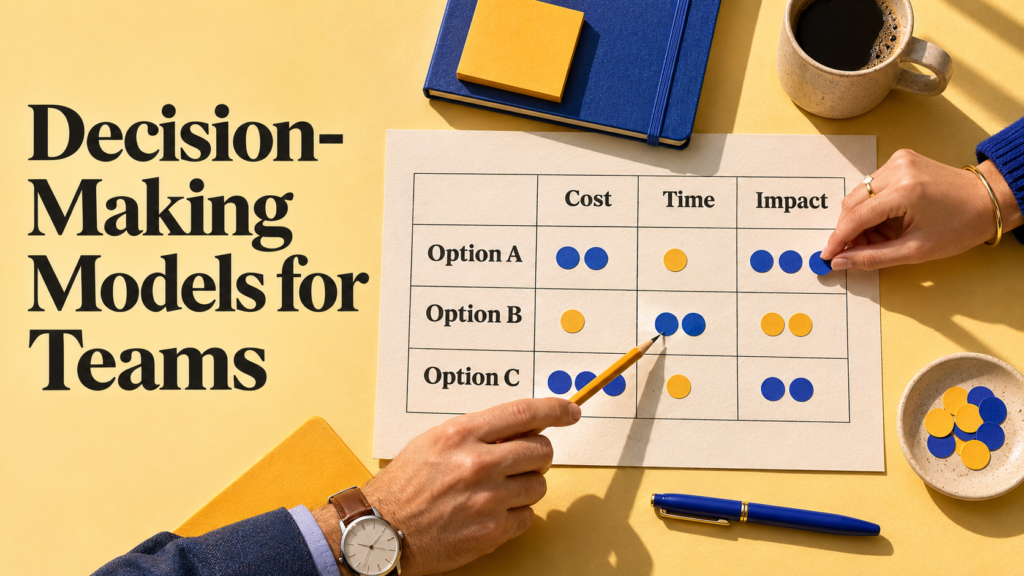
Agree on what a good decision looks like, such as cost, customer impact, risk and speed, before comparing options. A simple weighted scoring matrix can help.
Assign a Devil’s Advocate
Ask one person to argue against the leading option. This surfaces weaknesses and reduces the risk of groupthink.
Run a Pre-Mortem
Imagine the decision has failed a year from now and ask why. This technique helps teams spot risks they might otherwise overlook.
Set a Deadline
Open-ended discussions can drift. A clear deadline and a fallback rule, such as the leader deciding if consensus is not reached, keep things moving.
Biases That Distort Team Decisions
Groups are vulnerable to predictable biases. Groupthink occurs when the desire for harmony suppresses dissent. Anchoring happens when the first number or idea mentioned shapes all later discussion. Confirmation bias leads people to favour information that supports what they already believe. Sunk cost bias keeps teams investing in failing projects because they have already spent so much. Authority bias gives undue weight to the most senior person’s opinion. Awareness alone does not eliminate these biases, but structured techniques such as silent input, devil’s advocacy and clear criteria help reduce them.
Decisions With Legal and Financial Consequences
Some decisions carry significant risk. Approving large contracts, changing employment terms, making redundancies, handling data, entering new markets or committing to major borrowing may have legal, tax or regulatory implications. These decisions should follow formal governance processes, involve the right approvers and be properly documented. In many organisations, board approval or legal review is required above certain thresholds.
Clear decision records also matter for insurance and accountability. Directors and officers liability insurance, for example, is designed to protect leaders against claims arising from their decisions, but insurers and courts often look at whether decisions were made carefully, with appropriate information and advice. Good documentation of the reasoning, the options considered and the advice received demonstrates diligence.
Documenting and Communicating Decisions
Many teams make decisions in meetings and then forget the details. Keep a simple decision log recording what was decided, when, by whom, the reasons and any follow-up actions. Share decisions promptly with everyone affected and explain the reasoning, especially if some people’s preferences were not adopted. This reduces repeated debates and helps new team members understand past choices.
Reviewing Decisions
Review significant decisions after enough time has passed to see results. Ask what was expected, what actually happened, what information was missing and what the team would do differently. Focus on improving the process rather than blaming individuals, because good decisions can still produce bad outcomes when circumstances change unexpectedly.
A Fictional Example
Summit Software, a fictional software company with 60 staff, found that product decisions were constantly reopened. Developers felt ignored, while sales felt product changes were made without understanding customers. Leadership introduced a decision rights matrix for product changes, naming the product lead as the final decision owner after consultation with engineering and sales. Major roadmap decisions used a consent-based approach in a monthly meeting. Every decision was recorded in a shared log. Within a quarter, reopened decisions dropped sharply, meetings became shorter and teams reported feeling more heard.
Decision-Making in Small Businesses
In small businesses, the owner often makes most decisions, which works early on but becomes a bottleneck as the business grows. Delegating routine decisions within clear limits, such as purchasing up to a set amount or scheduling staff, frees the owner to focus on strategy. Writing down which decisions require the owner’s approval helps staff act confidently.
Tips for Better Team Decisions
- State the decision model before discussion begins
- Name one decision owner for every significant decision
- Agree on criteria before comparing options
- Collect silent input to reduce the influence of dominant voices
- Use pre-mortems for high-stakes or irreversible choices
- Record decisions and reasons in a shared log
- Review important decisions and learn from the results
Common Mistakes and Misconceptions
- Assuming consensus is always the best or fairest model
- Asking for input when the decision has already been made
- Leaving decision ownership vague or shared among many people
- Reopening decisions without new information
- Treating every decision with the same level of process
- Ignoring legal and governance requirements for major decisions
- Judging decisions only by outcomes rather than by the quality of the process
Final Thoughts
Good decision-making is a team skill that can be learned and improved. The starting point is clarity: knowing which model is being used, who owns the decision and what criteria matter. Command, consultative, voting, consensus, consent and delegated models each have a place, and effective teams choose deliberately based on urgency, impact, expertise and the need for commitment. Structured techniques such as silent input, pre-mortems and devil’s advocacy reduce bias and improve quality. For decisions with legal, financial or regulatory consequences, follow proper governance and document the reasoning carefully. Record decisions, communicate them clearly and review them over time. Teams that decide well move faster, argue less and stand behind their choices with far greater confidence.
Frequently Asked Questions
1. What is the difference between consensus and consent?
Consensus aims for everyone to actively support a decision. Consent means the decision proceeds unless someone raises a reasoned objection that it would cause harm. Consent is often faster while still respecting serious concerns.
2. How can a team avoid groupthink?
Encourage dissent, gather silent input before discussion, assign a devil’s advocate, invite outside perspectives and have leaders share their views last rather than first.
3. Should managers always involve their team in decisions?
Not always. Involvement is valuable when the decision affects the team, when they have relevant knowledge or when their commitment is needed. For urgent, routine or confidential decisions, the manager may decide alone and explain afterwards.