Why are some industries consistently profitable while others struggle even when demand is strong? Why do airlines often earn thin margins while some software and pharmaceutical companies earn far more? Michael Porter’s Five Forces framework offers an answer. It shows that profitability depends not only on direct rivals but on a wider set of competitive pressures, including customers, suppliers, potential new entrants and substitute products.
This guide explains Porter’s Five Forces in practical terms. It covers the origin of the framework, each force in detail, the drivers that make each force strong or weak, how to conduct a Five Forces analysis, how to use the results for strategy, examples, related concepts, limitations and common mistakes.
Table of Contents
Where the Five Forces Came From
Michael Porter, a professor at Harvard Business School, introduced the framework in a 1979 Harvard Business Review article titled “How Competitive Forces Shape Strategy.” He later expanded the ideas in his book on competitive strategy and revisited them in a 2008 article. Porter challenged the common view that competition was simply about rivalry and price. He argued that four additional forces also shape how much profit an industry can earn.
The core idea is that industry structure determines how value is divided. If customers, suppliers, new entrants or substitutes have a lot of power, they capture value that might otherwise become profit for companies in the industry.
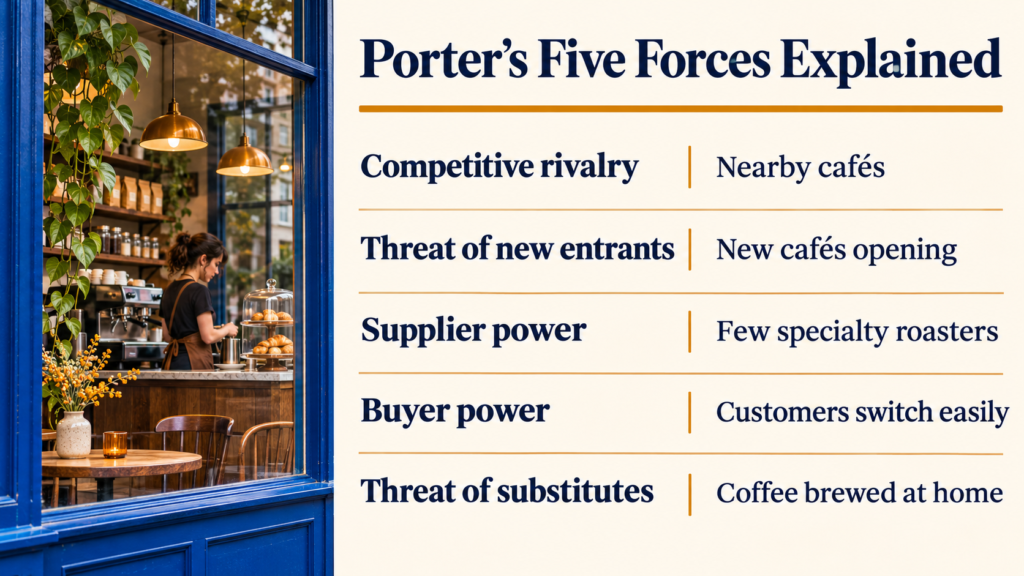
The Five Forces at a Glance
- Rivalry among existing competitors.
- Threat of new entrants.
- Bargaining power of buyers.
- Bargaining power of suppliers.
- Threat of substitute products or services.
Force 1: Rivalry Among Existing Competitors
Rivalry describes how intensely companies in an industry compete. Intense rivalry can drive down prices, raise marketing costs and reduce profits. Rivalry tends to be strong when:
- There are many competitors of similar size.
- Industry growth is slow, so companies fight for share.
- Products are similar, making price the main differentiator.
- Fixed costs are high, pushing companies to cut prices to fill capacity.
- Exit barriers are high, so struggling firms stay in the market.
Rivalry can take forms other than price, such as advertising battles, product launches, service improvements and promotions. Price-based rivalry is usually the most damaging to profitability.
Force 2: Threat of New Entrants
New entrants bring new capacity and a desire to gain market share, which can pressure prices and costs. The threat depends on barriers to entry, such as:
- Economies of scale that give large incumbents cost advantages.
- High capital requirements to start operations.
- Strong brand loyalty and customer switching costs.
- Access to distribution channels.
- Government regulations, licenses and permits.
- Proprietary technology, patents or know-how.
- Network effects, where a product becomes more valuable as more people use it.
When barriers are low, profitable industries attract newcomers quickly, which tends to erode returns.
Force 3: Bargaining Power of Buyers
Powerful buyers can force prices down, demand better quality or more service, and play competitors against each other. Buyer power tends to be high when:
- Buyers are few or purchase in large volumes.
- Products are standardized, so buyers can easily switch.
- Switching costs are low.
- Buyers could produce the product themselves.
- Buyers are price-sensitive because the product is a large part of their costs.
- Buyers have good information about prices and alternatives.
Large retailers negotiating with consumer goods manufacturers are a classic example of strong buyer power.
Force 4: Bargaining Power of Suppliers
Powerful suppliers can raise prices, limit quality or shift costs onto industry participants. Supplier power tends to be high when:
- A few suppliers dominate the market.
- Their inputs are unique or critical.
- Switching suppliers is costly or difficult.
- Suppliers could integrate forward into the industry.
- The industry is not an important customer for the suppliers.
Supplier power applies to labor as well. Skilled workers in short supply, or strong unions, can capture a significant share of industry value.
Force 5: Threat of Substitutes
Substitutes perform the same or a similar function through a different product or method. They place a ceiling on prices. For example, video calls can substitute for business travel, and streaming services substitute for physical media. The threat of substitutes is high when:
- Substitutes offer an attractive price-performance trade-off.
- Switching costs for buyers are low.
- Customers are willing to try alternatives.
Substitutes are often overlooked because they come from outside the industry. Looking beyond direct competitors helps spot them early.
Summary of the Five Forces
| Force | Question It Answers | Signs the Force Is Strong | Effect on Profitability |
|---|---|---|---|
| Competitive rivalry | How intense is competition among current players? | Many similar rivals, slow growth, high fixed costs | Lower prices and margins |
| Threat of new entrants | How easy is it for newcomers to enter? | Low capital needs, weak brands, few regulations | Pressure on prices and share |
| Buyer power | How much leverage do customers have? | Few large buyers, low switching costs | Price cuts and higher service demands |
| Supplier power | How much leverage do suppliers have? | Few suppliers, unique inputs, high switching costs | Higher input costs |
| Threat of substitutes | Can customers meet needs another way? | Attractive alternatives with low switching costs | Caps on prices |
How to Conduct a Five Forces Analysis
Step 1: Define the Industry Carefully
The analysis depends on how the industry is defined. Is it all beverages, soft drinks or premium sparkling water? Too broad, and the analysis becomes vague. Too narrow, and important substitutes may be missed.
Step 2: Identify Participants
List current competitors, key buyer groups, important suppliers, potential entrants and substitutes.
Step 3: Assess Each Force
For each force, examine the drivers listed above and rate the force as low, medium or high. Use data such as market concentration, growth rates, margins, switching costs and regulatory barriers.
Step 4: Evaluate Overall Attractiveness
Combine the ratings to judge how attractive the industry is. Industries with mostly weak forces tend to support higher profitability.
Step 5: Identify Trends
Consider how each force may change over time due to technology, regulation, globalization or changing customer behavior.
Step 6: Develop Strategic Responses
Use insights to decide how to position the business, where to compete and how to shift forces in your favor.
Using Five Forces for Strategy
The framework helps companies make several kinds of decisions:
- Market entry: whether an industry is attractive enough to enter.
- Positioning: finding segments where forces are weaker.
- Reducing buyer power: differentiating products, building loyalty programs or increasing switching costs.
- Reducing supplier power: diversifying suppliers, standardizing inputs or integrating backward.
- Raising entry barriers: investing in scale, brand, technology or exclusive partnerships.
- Defending against substitutes: improving value, bundling services or moving into the substitute space.
Investors and lenders also use Five Forces thinking to assess industry risk before financing businesses or acquiring companies.
Related Concepts and Extensions
- Complementors: some strategists add a sixth factor for complementary products, such as apps for smartphones, which can increase industry value.
- Government role: Porter treated government as influencing the five forces rather than as a separate force.
- Value chain analysis: examines a company’s internal activities, complementing the external Five Forces view.
- Generic strategies: cost leadership, differentiation and focus are Porter’s companion ideas for how companies can position themselves.
Limitations of the Framework
- It offers a snapshot and may not capture fast-changing industries well.
- Industry boundaries are increasingly blurred, especially in digital markets.
- It focuses on competition and may underplay cooperation and ecosystems.
- It analyzes industries, not individual company capabilities.
- Ratings can be subjective without good data.
Despite these limits, the framework remains one of the most widely taught and used strategy tools because it encourages structured thinking about profitability.
Practical Tips
- Use real data on market shares, margins and growth rather than opinion alone.
- Talk to customers and suppliers to understand their leverage.
- Look outside the industry for substitutes.
- Repeat the analysis for different segments, as forces vary between them.
- Focus on the most important forces rather than treating all equally.
- Combine with PESTLE to understand how macro trends affect each force.
Common Mistakes
- Defining the industry too broadly or too narrowly.
- Listing forces without assessing their strength.
- Confusing high growth with high profitability.
- Ignoring substitutes and focusing only on direct rivals.
- Treating the analysis as static.
- Failing to link findings to strategic decisions.
A Quick Illustration
Consider a fictional local ride-hailing market. Rivalry is intense because several apps offer similar services. Buyer power is high because riders can switch apps instantly. Supplier power is significant because drivers can work for multiple platforms. Substitutes include buses, bikes and private cars. Barriers to entry are moderate, given the need for technology and scale. This combination helps explain why profitability in such markets can be difficult, and why firms invest heavily in loyalty programs, driver incentives and network effects.
Five Forces for Startups and Investors
Startup founders can use Five Forces to test whether a market is worth entering before investing savings or raising capital. Investors and lenders use similar thinking to judge whether a business can sustain profits once competitors respond. A clear Five Forces assessment in a pitch deck or business plan shows that founders understand who holds power in their industry and how they intend to build defensible advantages, such as switching costs, network effects or exclusive supplier relationships.
Questions to Guide Your Analysis
- Which force currently takes the most value away from companies in our industry?
- Which force is changing fastest, and why?
- Where could we reduce buyer or supplier power through differentiation or partnerships?
- What barriers protect us today, and how long will they last?
- Which substitutes are customers starting to try?
Answering these questions as a team turns the framework from a theory into a practical planning exercise.
Combining Five Forces With Company Analysis
Five Forces explains the industry, but two companies in the same industry can earn very different returns. Pair the analysis with an internal review of capabilities, costs and brand strength. The goal is to find a position where your strengths match the spots where industry forces are weakest, and to build defenses where forces are strongest.
Final Thoughts
Porter’s Five Forces remains one of the most useful ways to understand why industries differ in profitability. By examining rivalry, the threat of new entrants, buyer power, supplier power and the threat of substitutes, managers can see who captures value in an industry and why. The framework supports decisions about market entry, positioning, pricing, supplier management and building barriers to competition. Its limitations, including blurred industry boundaries and a static view, mean it works best alongside tools like PESTLE, value chain analysis and competitor research. Used with good data and a clear industry definition, Five Forces helps businesses find positions where they can earn lasting returns.
Frequently Asked Questions
1. What are Porter’s Five Forces?
They are competitive rivalry, the threat of new entrants, the bargaining power of buyers, the bargaining power of suppliers and the threat of substitute products or services.
2. When did Porter introduce the Five Forces?
Michael Porter introduced the framework in a 1979 Harvard Business Review article titled “How Competitive Forces Shape Strategy” and revisited it in 2008.
3. Is the Five Forces model still relevant?
Yes. While digital markets and ecosystems complicate industry boundaries, the framework remains widely used to assess industry attractiveness and competitive pressures.